
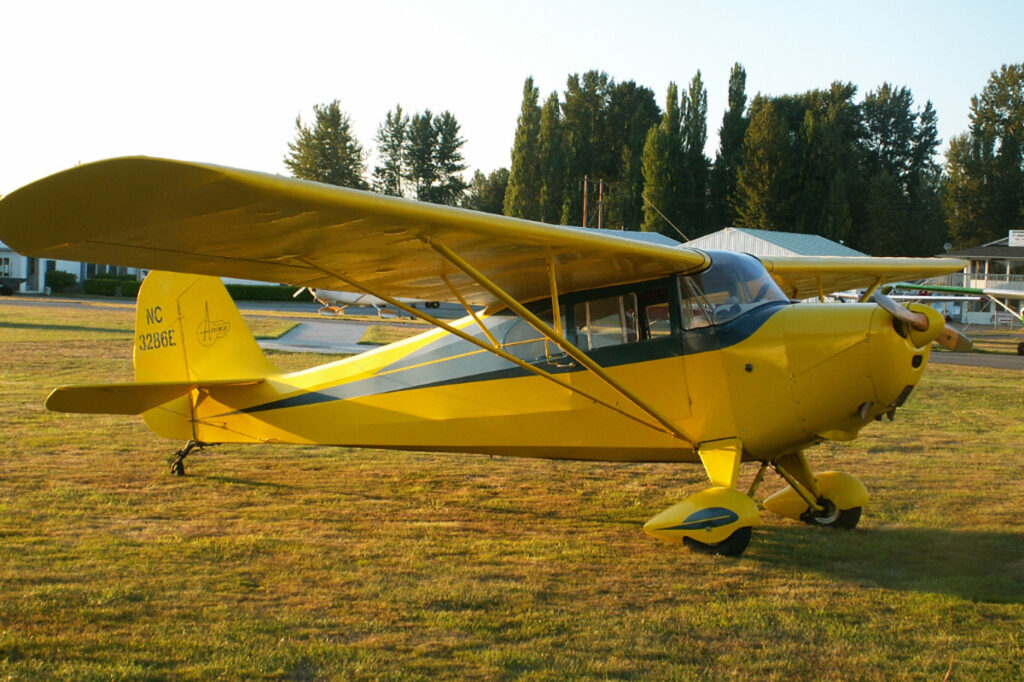
It doesn’t have the reputation of the Cub. Nor is it as well-known as a Taylorcraft, or as fast and maneuverable as a Luscomb. And, it’s not even close to being the most popular plane its manufacturer made. But the Aeronca Chief could well be the perfect aircraft if you’re looking for a side-by-side vintage plane. “It’s an absolute delight to fly… and one of the most inexpensive airplanes when it comes to purchase and long-term maintenance costs,” contends Mark Peterson, a Seattle area Chief owner and member of the Board of Directors of the National Aeronca Association. He says an estimated 700+ Chiefs are still flying, and that it’s usually not difficult to find one in good condition at a very reasonable price, especially in comparison to other similar vintage aircraft. “Back in the 60’s, when the EAA vintage movement got moving, people recognized that the Chief was an easily restored aircraft,” Peterson details.
Development, Features and Flight Characteristics
Aeronca, which began as the Aeronautical Corporation of America, was founded November 11, 1928, in Cincinnati, Ohio. It’s credited as the first American company to build a commercially successful general aviation aircraft, according to Donald M. Pattillo in his book “A History in the Making: 80 Turbulent Years in the American General Aviation Industry.” By the time the company ceased production in 1951, Aeronca had sold more than 17,000 aircraft, including more than 2418 Chiefs, according to Peterson. The aircraft was marketed as a ‘step up’ from Aeronca’s best-selling plane, the Champ, of which more than 8100 were produced. The first versions of the Chief appeared shortly before the war, some of which were used to train WWII pilots, but you’re most likely to find a post-war Chief 11AC for sale most of the time given overall production numbers.
Specifications for the Chief are readily available online, but you’re basically looking at a tube and Ceconite fabric plane that has a cruise speed of 82 kts, max speed of 90 kts, stall around 33 kts, climb rate of 450 fpm, useful payload of about 450 lbs. and a max takeoff weight of 1250 lbs. The 11AC was built with a 65 hp Continental engine. The 11BC and 11CC versions had 85 hp Continentals. You might find an AC that’s was later upgraded with an 85 hp engine. The Chief’s ‘deluxe’ interior featured a corduroy covered bench seat and rubber floor mats. The plane is often noted for its zebrawood instrument panel, the finish of which was actually rolled on in ink. (Peterson says the finish was common for commercial cash registers at the time.) Also of note, the Chief features an Oleo Strut system that’s arguably superior to the spring gear and bungee suspensions used by its competitors. The main fuel tank holds 15 gallons and sits between the engine and cabin. There’s also an 8-gallon auxiliary tank behind the cabin. AOPA’s “Budget Buys” report on the Chief calls the location of the main tank one of the plane’s few shortcomings, as there is a risk of rupture and fire following a crash. The setup, however, was typical for most planes of the period. A plus to the fuel system is that given the overall volume and the Chief only burning 4.5 gallons per hour, the plane has longer legs than most of its competitors.
There are a few things you have to get used to with a Chief. First, the plane isn’t known for being easy to get into, especially if you’re above average size. Peterson says pilots over 6 foot are going to be a little cramped. And if you’re short, but a little wider than you should be, then it’s going to be tight inside. (But that’s true with just about every plane from the period.) The Chief does, however, reportedly have more legroom than a Luscombe or Ercoupe. The second thing about the Chief: There are heel brakes, but just for the pilot—also a common configuration at the time. Some pilots complain the brakes lacking power, but others say they’re more than sufficient if you’re not moving at inappropriate speeds on the ground. (There are hydraulic/toe-brake upgrade kits available if you want to go that route.)
Also unique to the plane: a tachometer that reads backwards, and identical carburetor-heat and cabin-heat knobs on opposite sides of the throttle that can easily be confused. You’ll also need to learn to control fuel flow between the main tank and the header when on the ground so you don’t overflow the aft tank and start spilling fuel. You’ll also very likely have to hand-prop the plane, even though every 11AC came with a McDowell Safety Starer that allowed you to turn the engine over from inside the cabin. It’s generally thought these hand-operated, spring-loaded starters were unreliable, but Peterson believes few pilots really understood how the McDowell system worked and either destroyed them through mis-use, poor service and/or removed them to save weight. (There are some parts available if you’ve like to have a working McDowell system for your Chief.)
Just about everyone who’s piloted a Chief will tell you it’s a wonderful flyer. Peterson calls it a very stable plane that has a center of gravity nearly impossible to get out of whack. “It’s a great trainer for adverse yaw too,” he adds. “When you turn the yoke the nose will lazily turn the direction you want to go, but it will go the opposite direction first.” Peterson says you can’t have lazy feet with a Chief, but that with its docile nature and very effective rudder it’s not a difficult aircraft to fly. The rudder, he says, also gives you very good control on the ground while taxing, so much so that you only need brakes for the sharpest of turns. “The Chief has very powerful trim control too,” Petterson adds. “It’s effective without being touchy, and when you go to land you just trim all the way back to get the plane to settle in at 60 mph…right where it’s supposed to be.”
Power-off stalls on the Chief are usually subtle affairs, according to experienced pilots. The plane is likely to just fluff around as it quickly starts to sink. Power-on stalls, however, will probably show a definitive break, and the plane will roll off if you don’t coordinate things correctly. Quickly reducing the angle of attack while adding maximum power is critical for the safest recoveries. Pilots also report the plane glides better than you might expect, something to watch for when landing. Peterson says two and three-wheel landings can be made quite easily when you get the speed right. Also of note, the Chief doesn’t have flaps, but it can slip quite nicely. And, while the view out of the Chief is typical of most vintage high wings—somewhat limited—you will appreciate the plane’s sliding windows on warm days. The view over the cowl is such that you’ll want to weave a little while taxing to be safe.
Pre-Buy Inspection
You really want someone who’s familiar with planes like the Chief to do a pre-buy inspection if you’re thinking of buying one, according to Joe Flood, an A&P and owner of 3J Aviation in Franklinville, NJ. “You should see the vintage planes some first-time customers bring to me,” he exclaims. “The ones serviced by A&P’s who don’t know much about tube and fabric aircraft…well, sometimes it’s not so good…and certainly not safe.” Flood knows his way around Chiefs. He restored one when he was in high school, and that plane won an award at Oshkosh in 2013 for its pristine cockpit. That plane is now in the possession of YouTube aviation star Joe Costanza, better known as ‘Bananasssssssss.’
Flood says there’s nothing unique about the Chief that requires special attention during inspection. You’ll want to see if the wings were rebuilt when the fabric was last removed for a close look at the wings. There were ADs in 1997 and 2000 regarding inspection of the plane’s wooden spars, but Peterson reminds us not to be nervous about wood being used in the wings. “Wood often gets stronger as it ages if it’s taken care of,” he says. The Ceconite fabric, for which the standard ‘punch test’ doesn’t really work, can last 30 years or more if the plane is taken care of properly. If you do have to hire someone to replace the fabric you will likely spend more on that than you did on the plane itself. As usual, check the paperwork carefully to see if the proper STCs were obtained for modifications to the plane.
Maintenance and Ownership
The Chief is a fairly simple aircraft, and it generally doesn’t require too many dollars to get it through an annual. Parts are typically easy to find and relatively inexpensive. It helps that the plane shares 70-percent or more of its parts with the even more popular Aeronca 7AC Champ. And in addition to the availability of used parts, a number of small manufacturers make new parts to help keep Champs and Chiefs in the air. Given this, the plane’s fuel-sipping nature and the comparative low cost of purchase, you’re looking at one of the better bargains in aviation.
And if you buy a Chief, you’ll have the chance to join a well populated aviation niche. “’Aeronca Type Clubs’ are common and can be very helpful to new owners because of the accumulated knowledge of the members,” explains Peterson. “There are some real experts there who are more than willing to share what they know and lend a hand.” Additionally, Aeronca fly-ins are quite common, and more often than not there will be another Aeronca owner at just about every airport you land at. Peterson says, at the very least, you’ll be greeted with smiles and a ‘I used to fly one of those’ every time.’


I used to fly with a friend of mine when we were both going to school for our A and P licesnses..I already had my Commercial/Instrument/Multi/Flight instructor/Ground instructor licenses. And the only thing I did not like was flying at altitude…it seemed with that little engine it took for ever to get from point A to point B. Down on the deck was much more fun
My first few hours of dual instruction were done in a Chief at Governor’s Airpark in Matteson, Illinois, in 1953. FBO Walter Thielman, flight instructor. Just out of high school, didn’t own a car, so I would ride a bicycle from our home in Steger, about 3 miles, to get flight instruction on the Chief for $ 10 an hour – Including pilot and fuel !
That sounds a lot like my aviation origin story. I flew out of the Coeur d”Alene Air Terminal (COE) in the 1960s, renting an Aeronca 7AC for $8 an hour. I think the instructor’s rate at that time was $4-$6 an hour, and 80/87 octane aviation fuel was around $0.28 per gallon. Great times.
Comments are closed.