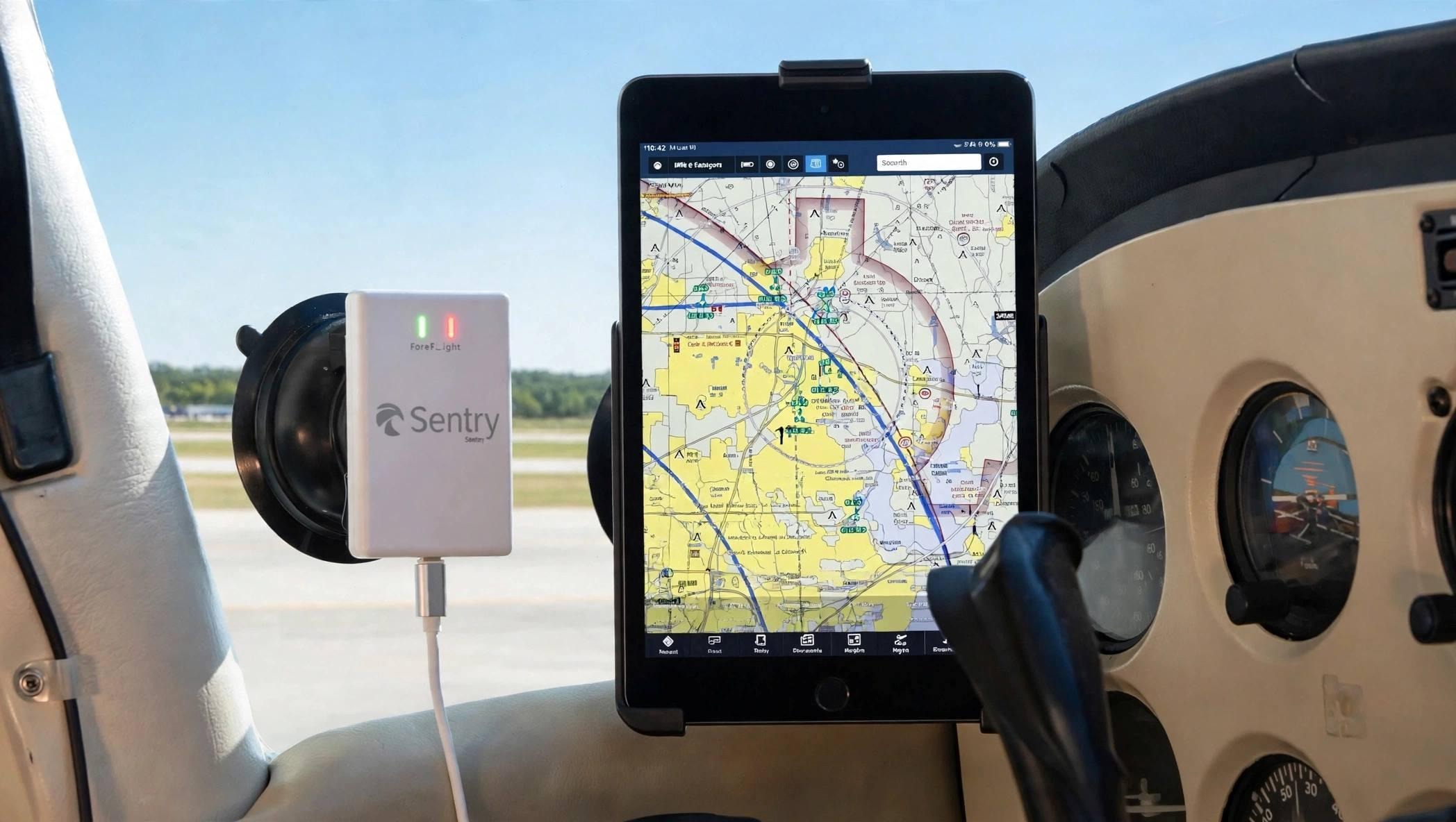
An iPad and an aviation app sound like one purchase. In practice, an electronic flight bag is a small integration project, and Sharks Technologies is selling it as a kit.
For many pilots, adopting an electronic flight bag (EFB) starts with what looks like a simple decision: buy an iPad and install an aviation app. That decision quickly turns into a chain of related questions. Which iPad fits the cockpit? Does it need the cellular model? Where will it get GPS position? Which ADS-B receiver works with the chosen software? Where will the tablet mount, and how will everything stay powered on a long flight? Each answer affects the others, and the parts usually come from different electronics retailers, aviation suppliers and accessory makers. The problem is not a shortage of good products. It is that buying and setting them up is fragmented.
Wi-Fi or Cellular
The iPad mini is a practical size for smaller cockpits, but the choice between the Wi-Fi and Wi-Fi + Cellular models matters. The Wi-Fi-only iPad has no GPS receiver of its own; it can still display position from a compatible external receiver. The cellular model includes satellite positioning that works without a paid data plan, giving the pilot a second position source. Cellular service is not a substitute for downloading charts and flight data before departure. A student pilot flying with a reliable external GPS receiver may be well served by the Wi-Fi model. A pilot who wants an independent GPS source may prefer the cellular version.
What the ADS-B Receiver Adds
A portable ADS-B receiver delivers subscription-free FIS-B weather, traffic and GPS position to the EFB app. Receivers differ in features, and none shows every aircraft: a portable ADS-B In unit displays aircraft broadcasting ADS-B Out plus whatever ground stations rebroadcast. FIS-B weather products can be several minutes old and are for strategic planning, not for picking a path through hazardous weather.
ForeFlight’s Sentry Mini provides dual-band traffic, weather and WAAS GPS. It has no internal battery and runs from a 5-volt, 2-amp USB source. The full Sentry adds a backup attitude reference (AHRS), a pressure-altitude sensor, a carbon monoxide detector and alarm, and an internal battery rated for about 12 hours. Those differences matter more than the price gap. A new VFR pilot and an experienced cross-country pilot will weigh them differently. In either case, portable ADS-B In supplements, and does not replace, installed equipment, visual scanning and sound procedures.
Accessories Are Part of the System
A well-chosen tablet and receiver can still be frustrating if the physical installation is an afterthought. A kneeboard may suit a trainer; a suction or yoke mount may give a better viewing angle in another airplane. Any mount must clear full control travel, leave instruments visible and not obstruct egress. Cases and antiglare films help with handling and readability, but sunlight and cabin heat still deserve attention, both for the iPad and for suction cups.
Power planning is just as important. A 10,000 mAh backup battery, a suitable USB-C charging adapter and the right cables add resilience, provided the pilot checks actual endurance, the aircraft’s power outlets and how each device behaves while charging. An externally powered receiver such as Sentry Mini and a battery-powered receiver such as Sentry have different requirements.
Homebuilders have some extra homework. Panel space is often tight, bubble canopies change where a suction mount or receiver can go, and many experimental panels already carry an EFIS with ADS-B In. In that case a portable receiver may duplicate what is already installed, and the iPad’s job may be planning, charts and backup rather than primary traffic and weather.
AeroView Bundles
One answer to all this is to buy the hardware as a coordinated package. Sharks Technologies, which assembles its kits in Philadelphia, takes that approach with its AeroView line. Each kit combines an iPad mini, a ForeFlight Sentry receiver, mounting hardware, protection and power accessories in a defined configuration. The ForeFlight subscription is separate. A kit does not mean every airplane or mission has the same needs, or that setup checks can be skipped. It means the pilot starts from a known combination rather than researching every interface independently.
AeroView Basic, listed at $1,399, pairs a Wi-Fi iPad mini with Sentry Mini, a rotating kneeboard, a case and screen protector, a backup battery with USB-C adapter, and a pilot organizer. It is aimed at students and pilots new to EFBs. AeroView Plus, at $1,699, moves to the cellular iPad mini with built-in GPS, keeps Sentry Mini and adds suction and yoke mounts. AeroView Pro, at $2,099, combines the cellular iPad with the full Sentry receiver and the PIVOT case and mounting system. The differences come down to GPS redundancy, receiver functions and mounting flexibility.
Fewer Transactions
Buying the parts separately can mean several shipments, delivery dates, return policies, compatibility questions and warranty contacts. Finding suitable parts and sorting out mismatches takes time, even if it never appears on a receipt. Sharks describes its model as one shipment, one Sharks warranty of one year on the bundle, and U.S.-based customer support. That may appeal most to pilots who would otherwise be coordinating among several vendors. Anyone comparing costs should price the components individually, including shipping and tax; a bundle is not automatically the cheapest route.
What to Verify Before Flight
A preselected kit is a starting point, not a substitute for evaluating it in the cockpit. Confirm mount clearance in the specific airplane, charging connections, downloaded chart coverage, receiver placement and connectivity before flight. Understand the limits of portable weather and traffic, and carry suitable backups. Flight instructors can help students use an EFB without letting it distract from basic navigation and aircraft control.
Whether a pilot assembles an EFB piece by piece or buys it as a kit, the test is the same: will the complete setup work reliably and comfortably in the airplane where it will actually be used? For more information, visit sharkstechnologies.com.