
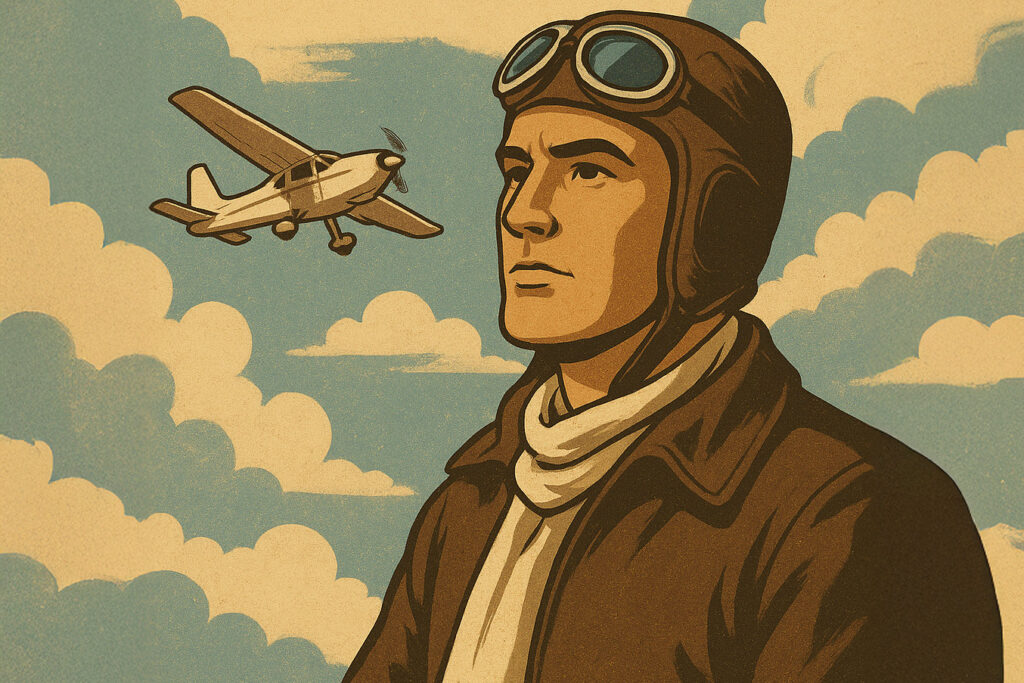
“Oh, he (or she) is just a natural pilot,” is a compliment often bestowed on someone who’s displayed impressive piloting skills. Can it be that certain individuals have been blessed with “bird blood” that courses through their veins, giving them the ability to fly an airplane ever so much more easily than we normal mortals?
Of the hundreds of people I’ve guided toward their pilot certifications, not too many displayed such a natural ability to control the aircraft. Most of us learn our trade with painstaking practice, encountering plateaus of stubborn frustration until breaking up onto a higher level of competency. I am, after 65 years into a continuing education in the art, thought of as a capable pilot. But I have to work at it; as I’ve been known to tell people, “It shore don’t come easy to me.”
Which makes it particularly nettlesome to ride with someone who makes it look effortless, carving a line through the sky with nary a bobble from solidly-held attitudes, performance indicators frozen as if the needles were painted on the gauges. Why can’t I do that? Is it because they are a “natural pilot?”
Bringing Skills To The Task
Transference of abilities from other pursuits may be of some value when learning to fly. I’ve always compared learning to fly airplanes with mastering a musical instrument; these are not machines, I stress. Instead, they should be handled as an instrument of our biding, and as such we must become a part of the aircraft, attuning ourselves to its soul. Feel its response to the controls, let the plane talk to you, listen to what it’s saying
I’ve observed that skilled construction equipment operators usually learn how to get what they want out of an airplane, once they get past attempting to jostle hydraulics and blip actuator motors in a futile effort to fly it like a machine. They can adapt to the desires of any piece of equipment, for the most part.
Smoothness at the controls, getting an airplane to perform with a minimum of jockeying inputs back and forth, is a highly-desirable art. I have ridden with pilots who seemingly operated the airplane as an extension of their will, with never a wasted motion, as if the aircraft was mounted on ball-bearings. One such individual obtained his commercial rating under my tutelage, after years of flying as a rather ordinary private pilot. He obviously had spent the time adding to his rudimentary skills, and there was not a lot of instruction wasted mastering the tighter tolerances of the commercial-pilot standards.
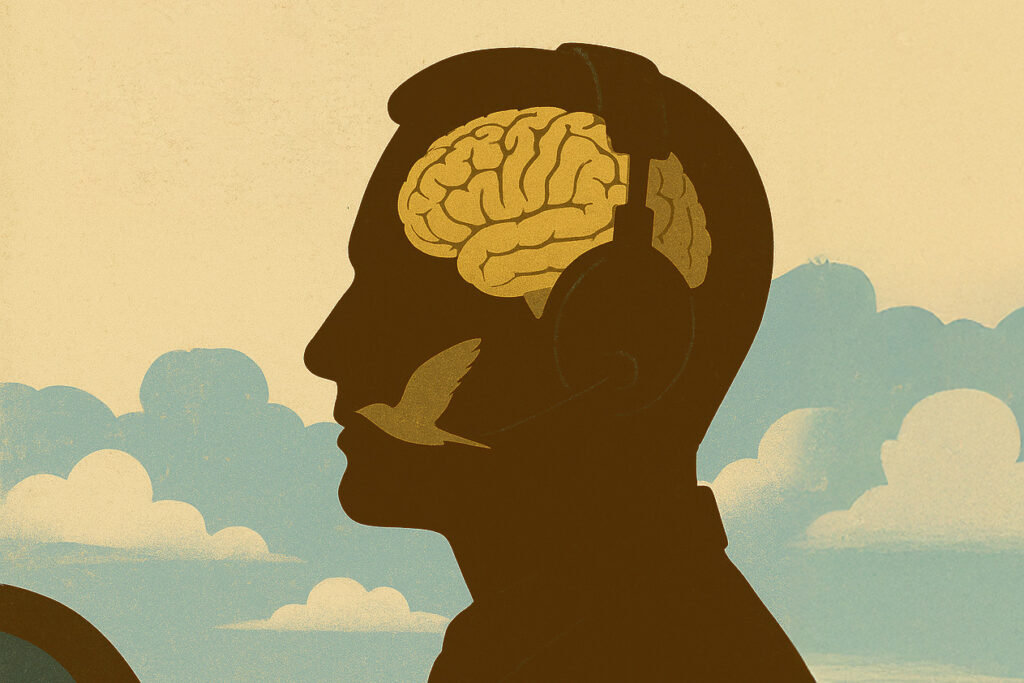
In the military, a superior pilot is known as a “good stick.” They get the job done with higher marks in training, adapt well to new tactics and equipment, outfly their competitors and get their choice of assignments. Not always are they able to take their military-honed skills into civilian crew cockpits or team operations, but they can sure as heck fly.
Historically speaking, top-scoring combat pilots weren’t always the best at flying. Manfred von Richthofen, the famed “Red Baron,” was barely able to graduate from flight training because he treated his airplane like a cavalry horse, simply a tool of his trade, which was shooting down other pilots. Similarly, heroic record-setters sometimes focused on achieving their goal, rather than flying the airplane.
I’ll never forget my young student Kenette Rae Powell. At 17, she would meet me at dawn before school, eager to pursue flying. I soon learned that she was a perfect mimic. I could show her any maneuver and she would repeat it, errors and all; I had one chance to get it right, or her technique would be similarly flawed. Her disgusting display of aptitude eventually took her into Navy fighter cockpits, and beyond.
Nature Or Nurture?
While a few fortunate individuals seem to be born to the flight deck, there are those at the opposite end of the curve who acquire just enough skill to meet the ACS requirements for the checkride, and there they remain. They operate the controls crudely, never feeling the airplane’s protestations. Every two years, they come to me for a Flight Review, still meeting the standards but never improving over them. One has to wonder where those hours logged in the past 24 months went. It wasn’t into their skill set.
Between these two extremes lies most of our pilot population. Like myself, you probably put in hours of diligent practice to hone your craft, and it takes constant revisiting of the workout regime to keep up proficiency. When I train a student, we frequently encounter the frustration of plateaued progress; no matter how hard we try, he or she seems to bounce off a wall of impediment. Until the day it finally clicks, the light turns on, the performance becomes second nature, and they are ready for another challenge. Precise flying requires some hard work.
I well recall practicing for my first ATP checkride. In those days, there was no recommendation, no course completion, no instructor’s approval. When you met the prerequisites and thought you were ready, you made an appointment. There was a slim book of Practical Test Standards that would determine the outcome. I spent many circuits grinding around the ILS pattern, one engine zero-thrusted, trying to will the crossed localizer/glideslope needles to stay in place all the way down to minimums. Success came not from any natural ability but from plain old practice, perhaps aided by gusty air on checkride day and the generosity of the FAA Inspector who had drawn the short straw.
My old mentor Edgar L. Robertson had the ability to stay away from the controls for a month, and then come back to fly as if he had been airborne every day. His landings, ever the judgment criteria of a watchful critic, would be on target, stabilized down the approach path, squeaked onto the pavement without a jar. By comparison, after I’d had a week off I could imagine where I wanted the plane to go, but there would inevitably be a shortcoming in my results.
Does age play a role? At the basic level, a dedicated young person probably has an edge over a seasoned citizen, but there’s more at work here than youthful reaction time. In teaching flight, I’ve seen a lot of sloppy teens and collegiate wannabes drop out. Desire is a sustaining factor when it comes to plowing through the obstructions in a curriculum. If the youngster grew up in a flying family, observing good outcomes as well as inept ones, that combination of youth and experience is a definite advantage. However, being flexible enough to cast away inherited faulty techniques, in order to meet the school’s training standards, is also important.
Not every pilot is naturally good at every task. You and I can fly a proper landing approach, but can’t spray herbicides three feet above a crop field. Performing aerobatics is altogether different from flying an accurate cross-country trip. Controlling the airplane, simultaneously complying with an instrument approach procedure in rough air, while deciphering communication complexities, is akin to juggling three oranges in the cockpit. Stick and rudder skills are important, but so is application of them to changing situations. Knowledge and judgment are both necessary ingredients of safe piloting, as much or more so than innate skill.
Can there be truly natural aviators, superior “ace of the base” beings who immediately take to flying as second nature? Yes, I have seen them, so I know they exist. I’d say perhaps 5% of rated pilots enjoy such status. Maybe 15% are classed as simply “airplane drivers,” lacking finesse as they jerk and bang the airplane through its paces. However, we mundane middle of the pack persons, the other 80%, can reach superior pilot status, simply by putting in the time and work.



Thank you for such an insightful article; it really resonated with me. I started learning to fly in my late 30s with no real exposure to aviation beyond watching airplanes in movies and cartoons. Despite an unbounded desire to fly, the journey was genuinely challenging. I still enjoy it deeply and try to immerse myself in aviation every minute I can spare, even though it is not a career path for me.
I stuck to a consistent schedule, flying once a week for at least an hour, yet it took me about two years to earn my private, one year for instrument, one year for commercial, and another year for my CFI. Along the way, I came to understand that I am someone who simply needs more repetition and practice to truly internalize things.
There were times when I compared myself to stories of people earning their PPL in under 70 hours or finishing instrument training in just a couple of months, and I felt like I was somehow missing something. What I have learned, though, is that consistency and drive can outweigh those seemingly natural or taken-for-granted skills others may have. Persistence matters, and for some of us, that is the real power.