
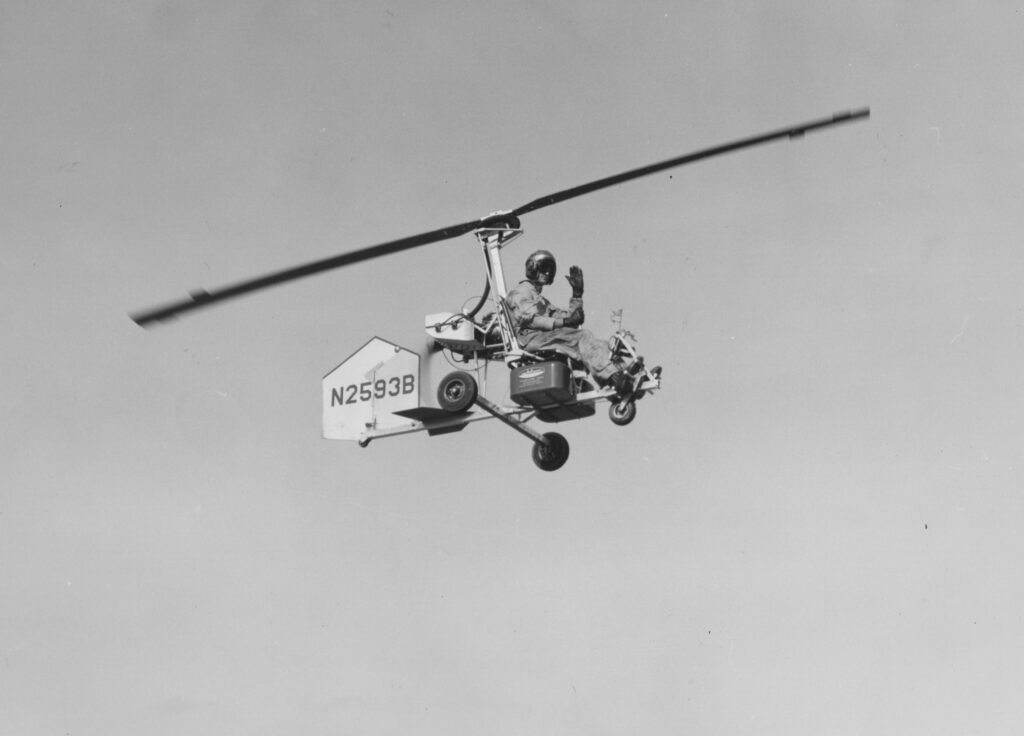
The autogyro, with its unmistakable silhouette and ingenious simplicity, has long fascinated aviation enthusiasts. The concept attracted pilots interested in the idea of rotary-wing flight without the technical complexities and costs associated with the helicopter.
Popular interest in the “gyrocopter” soared in the 1950s when Igor Bensen coined the term and introduced the Bensen B-8M. In 1955, small ads for the Bensen Gyrocopter began appearing in popular magazines like Popular Mechanics, Popular Science, Mechanics Illustrated, and Boy’s Life. Thousands of sets of plans for the machine were sold for $30. And kit builders bought thousands of Bensen B-8M kits from its introduction in 1955 into the 1970s. The B-8M designation set the model apart from the original B-8, an unpowered tow-launched gyro glider.
Throughout their history, the gyrocopter—sometimes called “gyroplane” or “autogyro”—stands out as both curiosity and triumph. For those of us who have spent years explaining the quirky silhouette slicing the sky at close-to-stall speeds, persuasive enthusiasm for these machines arises from their role in democratizing rotary-wing flight. Compared to the mechanical complexity (and cost) of a true helicopter, the homebuilt gyrocopter represents mechanical honesty, functional elegance, and, perhaps above all, accessibility.
The saga of homebuilt gyrocopters spans nearly a century, with roots in the awkward, wind-battered flights of Juan de la Cierva’s early autogyros, through Igor Bensen’s postwar innovations, to the homebuilders who decided to experiment with chainsaw and drone engines. Its development is a story of persistence in creating lift by autorotation.
The Early Autogyro
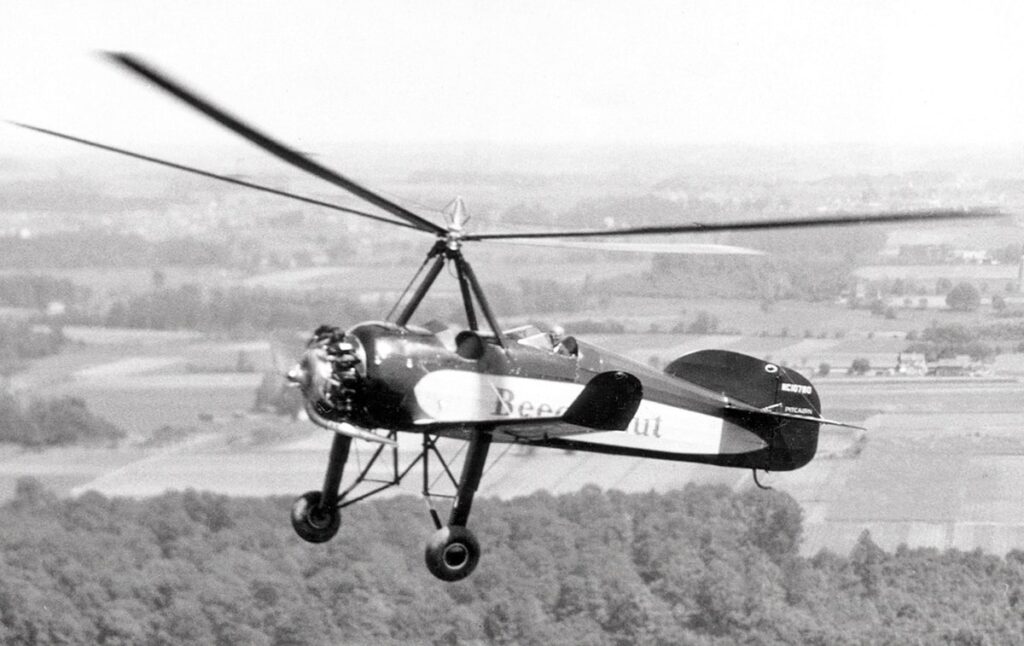
The first rotorcraft to demonstrate practical flight bore a resemblance to a helicopter but wasn’t one. It was Juan de la Cierva’s “autogiro,” which achieved controlled flight in January 1923. Confronted by the dangers of aerodynamic stalls, de la Cierva sought an alternative route to vertical lift: unpowered rotors kept in rapid rotation by forward movement through the air.
Unlike helicopters, autogyros relied on a conventional engine and propeller for thrust, but the lift came from the free-spinning blades overhead. The early C.4 model, built on an airplane fuselage, became a template for experimentation. Lateral control emerged through rudders and elevators, with the innovation of rotor hinges helping tame the unique aerodynamic stresses.
It didn’t take long for this technology to leap borders. By the late 1920s, autogyros took shape in British, American, and German workshops. In the U.S., Harold Pitcairn and the Kellett Autogyro Company played pivotal roles in adaptation and production. Amelia Earhart flew a Pitcairn PCA-2 autogyro to record altitudes in 1931. She demonstrated the efficacy of the plane on cross-country flights. But as helicopter advances captured government and commercial interest, the autogyro faded from mass production—maintained, for the most part, by enthusiasts, inventors, and a small but persistent cadre of homebuilt experimenters.
Yet, even as the world moved forward, the allure of the autogyro never really vanished. Its fundamental simplicity made it a favorite among amateur aircraft designers, particularly in postwar America when the culture of kit building found fertile ground.
Bensen’s Revolution: The Era of the Gyrocopter
Among homebuilders, no name looms larger than Igor Bensen. A Russian-born engineer educated at Stevens Institute of Technology, Bensen’s experience stretched from helicopter projects for General Electric to his own entrepreneurial leap in the early 1950s. The Bensen Aircraft Corporation, founded in Raleigh, North Carolina in 1953, seeded the modern gyrocopter movement. Bensen’s B-7 Gyroglider, a towed, engineless machine engineered for accessibility, gave way to the powered B-8M—the most influential homebuilt rotary-wing aircraft of the post war era.
What set Bensen’s designs apart was their intended simplicity. Metal tubing, basic mechanical assemblies, and bolt-together construction made the Bensen Gyrocopter approachable to anyone patient enough for two weeks of workshop labor. For readers accustomed to hours spent fabricating ribs, spars, and fabric coverings for homebuilt airplanes, the Bensen offered a refreshingly direct solution: a complete kit, or prepared plans, that could be finished by amateurs with nothing more than basic hand tools.

Builders could opt for the glider version, towed behind a vehicle with no powerplant of its own, or pursue the “Gyrocopter”—the engine-powered configuration permitted for licensed flight. Pricing information is all over the place from the era, but reasonable costs for a Bensen model ranged from as little as $995 for the basic glider kit to about $1,000-$3,000 for a fully outfitted B-8M, including a reconditioned McCulloch 72 hp engine, and new prop and rotor. I personally witnessed a couple of bad incidents involving the glider version and wanted nothing to do with it, but was fascinated, like most airport kids of the day, with the powered gyrocopter. A sense that flight was reverting to the garage surrounded the idea. No hangar was needed; there were no complicated control surfaces, and—significantly—no threat of stalls or spins.
Popularity exploded in the late 1950s and through the following decades, as Bensen’s company sold thousands of kits—often to clubs and groups who pooled resources for materials and workshop space. The effort required to get a Bensen in the air was minimal compared to most fixed wing homebuilts. Hobbyists found themselves participating in a project and a grass-roots aviation movement, one defined by the image of a machine that “if you can ride a bicycle, you can learn to fly.”
In one symbolic episode, the Spirit of Kittyhawk—Bensen’s own B-8M prototype—matched the distance, altitude, and duration of the Wright brothers’ inaugural flight in celebration of the 60th anniversary at Kittyhawk. Between 1967 and 1968, Bensen set twelve gyroplane records for speed, distance, and altitude, solidifying his invention’s place in aviation history.
Kits, Community, and the FAA
Instrumental to Bensen’s success was his dedication to distributing both hardware and knowledge. Detailed plans and instructional manuals enabled builders to understand both the construction and mechanical operation of their flying machines. Bensen’s documentation was so thorough that it was submitted to the FAA, lending credibility to the emerging “Experimental” category for rotary-wing aircraft.
FAA licensing rules for gyroplanes were, and remain, unique. Pilots seeking to fly a powered “Gyrocopter” first mastered the glider version, usually with club arrangements involving a towed car, ground relay, and pilot. Upon obtaining a student pilot certificate, i.e., passing a medical and written exams, and successfully completing flight proficiency demonstrations, a gyroglider pilot could qualify for a license.
The rotary-wing structure’s labor requirements differed sharply from fixed-wing designs. Construction commonly demanded just 100 to 120 hours. With minimal workshop equipment, even first-timers could bring their homebuilt dreams to fruition.
McCulloch Engines and the Spirit of Adaptation
As the homebuilt gyrocopter matured through the 1960s and beyond, powerplants evolved in lockstep. Here emerges an unlikely period aviation icon—McCulloch was more famous for chainsaws and drone units than for its role in aviation. McCulloch’s lightweight, air-cooled engines provided a feasible blend of power and simplicity for the first generation of powered Bensen gyrocopters.
A standard McCulloch Gyrocopter kit came outfitted with a 72-hp model 4318 engine, though pilots and builders experimented with various configurations depending on what was affordable and accessible. For many, these engines proved adequate for the modest demands of gyroplane flight—enough to fly safely yet remaining true to the minimalist roots of the autogyro. Dwelling in that sweet spot between simplicity and utility, the McCulloch engine came to symbolize the homebuilder’s knack for adaptation and making the most out of whatever could be found in the kit, garage.
Through the years, skeptics questioned the reliability and service life of McCulloch engines in the aviation role, driving the evolution toward Rotax, Subaru, Volkswagen, and other conversions. Still, the McCulloch era stands as a testament to the inventive spirit of homebuilt aviation.
Evolving Designs and Modern Movements
The Bensen B-8 spawned a generation of imitators and variants, as manufacturers and backyard designers borrowed liberally from its core principles. Newcomers experimented with composite rotors, improved tail designs, and refined rudders to solve quirks in ground handling and flight stability. The Rotor Flight Dynamics “Dominator” designed by Ernie Boyette and “Little Wing” tractor design by Ron Herron, among others, represented evolutionary steps toward increased safety, reliability, and comfort.
By the late 20th century, homebuilt gyroplanes had found their own niche among amateur engineers, tinkerers, and those who simply craved the kind of flight that arose from their labor. Some moved the needle further, introducing modern four-stroke powerplants and enclosed cabins; others stayed true to the elemental purity of Bensen’s blueprint, flying open-frame configurations at fly-ins and airshows from coast to coast.
Today’s designs are refined wonders with sleek cabins, technologically advanced rotors and modern engines. Designs by such manufacturers as U.S. OEM Silverlight Aviation’s American Ranger AR-1, with its highly refined Averso Stella rotor system and choice of Rotax engines, is a good example of today’s gyroplane kit offerings.
AutoGyro Cavalon, offer enclosed twoseat gyroplanes like the sidebyside Cavalon and tandemseat Calidus in both factorybuilt and kit (Experimental AmateurBuilt) forms, with kit Cavalon pricing in the mid$100K range and “quick build” assembly times typically quoted in singledigit days under supervised builderassist programs.
The enduring popularity of gyrocopters owes much to the persistence of communities—clubs, web forums, online discussion groups, and the occasional local meet-up—who share advice, swap parts, and keep the oral history alive. Today’s homebuilt gyroplanes benefit from digital resources, improved metallurgy, and cross-pollination with ultralight and LSA categories. Still, the essential experience remains: simple flight, honest engineering, and the tangible satisfaction of building a rotary-wing aircraft with one’s own hands.

Safety, Skill, and the Gyrocopter’s Future
For all its accessibility, gyrocopter flight is not without challenge. Safety depends on rigorous construction standards, careful training, and respect for aerodynamic limitations. The Bensen legacy proved that even the minimalist approach requires thoughtful attention to vibration management, control systems, and engine reliability. The modern homebuilt movement has grown more sophisticated, emphasizing four-stroke engines, pre-rotators, improved braking systems, and advanced cockpit instrumentation.
New builders are counseled to engage with veteran communities, study manuals carefully, and rely whenever possible on proven designs and supplier documentation—a lesson as poignant today as it was when Bensen first mapped his Erector-set-like assembly procedures.
The history of the homebuilt gyrocopter is, at its heart, the story of aviation’s perennial gift: the capacity for adaptation by ordinary builders. From Juan de la Cierva’s first flights in he 1920s to Dr. Igor Bensen’s revolutionary kits to the garage mechanics who found promise in the McCulloch drone engine, each chapter honors the principle that flight remains within reach for those willing to search, adapt, and build.
In a time when complexity often overshadows participation, the homebuilt gyrocopter circles back to what matters—aerodynamic clarity, mechanical honesty, and the simple, undiminished joy of flight. As the movement continues, there remains ample opportunity for innovation and tweaking. The gyrocopter stands as proof that the spirit of experimental aviation thrives—thrifty, resourceful, and optimistic.
![A CubCrafter’s Carbon Cub headed to Sun ‘n Fun in the time-honored tradition. [Credit: CubCrafters]](https://www.kitplanes.com/wp-content/uploads/2026/08/Carbon-Cub-UL.jpg?w=324&h=160&crop=1 "Sun ‘n Fun 2026 Highlights: Electric RV-10, Modular Avionics, and MOSAIC")

I am looking for a gyroplane club or similar enthusiast group in Western New York or Northwestern Pennsylvania. Anyone know of any contacts out there? Thanks
There is the Western New York Rotorcraft Association (PRA Chapter 49) https://www.facebook.com/groups/115014588118.
Beyond that I recommend contacting the Western New York Flying Club at Buffalo-Lancaster Regional Airport. While not a gyroplane specific organization, the members there will be able to inform you of other groups that address this niche. Best of luck!
M. Brink,
Im surprised you didn’t mention the Magni gyro in your article. They are excellent machines and deserve exposure and recognition.
thanks,
Andy schcolnik
Chicago
Andy, thanks for your comment about the Magni Gyro. The article, The History of Homebuilt Gyrocopters was intended to address just that–gyrocopter history. It did not aim to include all contemporary gyro brands. I do, however agree that the Magni deserves more exposure, and I will see that it gets it in the forthcoming issues of Kitplanes.
My son is very interested in gyrocopters especially the old Benson’s
There is less interest in buying gyro because price had increase too much.I remember my first brand new 2 seaters gyro Ela made in Spain for 35000€ that has jumping now at 70000€ for not much improvement..I believe that every body is waiting for drone..wait and see.My dad born in 1904 in Verdun has been a pilot who start flying on first world war planes and finish 65 years later on Mirage…I follow a bit as a private pilot on Stamp sv4 at 1 USD charged an hour in 1959
Comments are closed.