Air racing fans have been anticipating this week’s Pylon Racing School at Roswell, New Mexico, with various levels of hope and curiosity. It’s everyone’s first opportunity to see or run on the new pylon course—plus, anyone wanting to race in September must run on the course prior to racing, says the FAA. So you’d think the turnout by the end of the week would be large—as in, an entire field of seven classes.
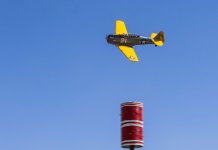
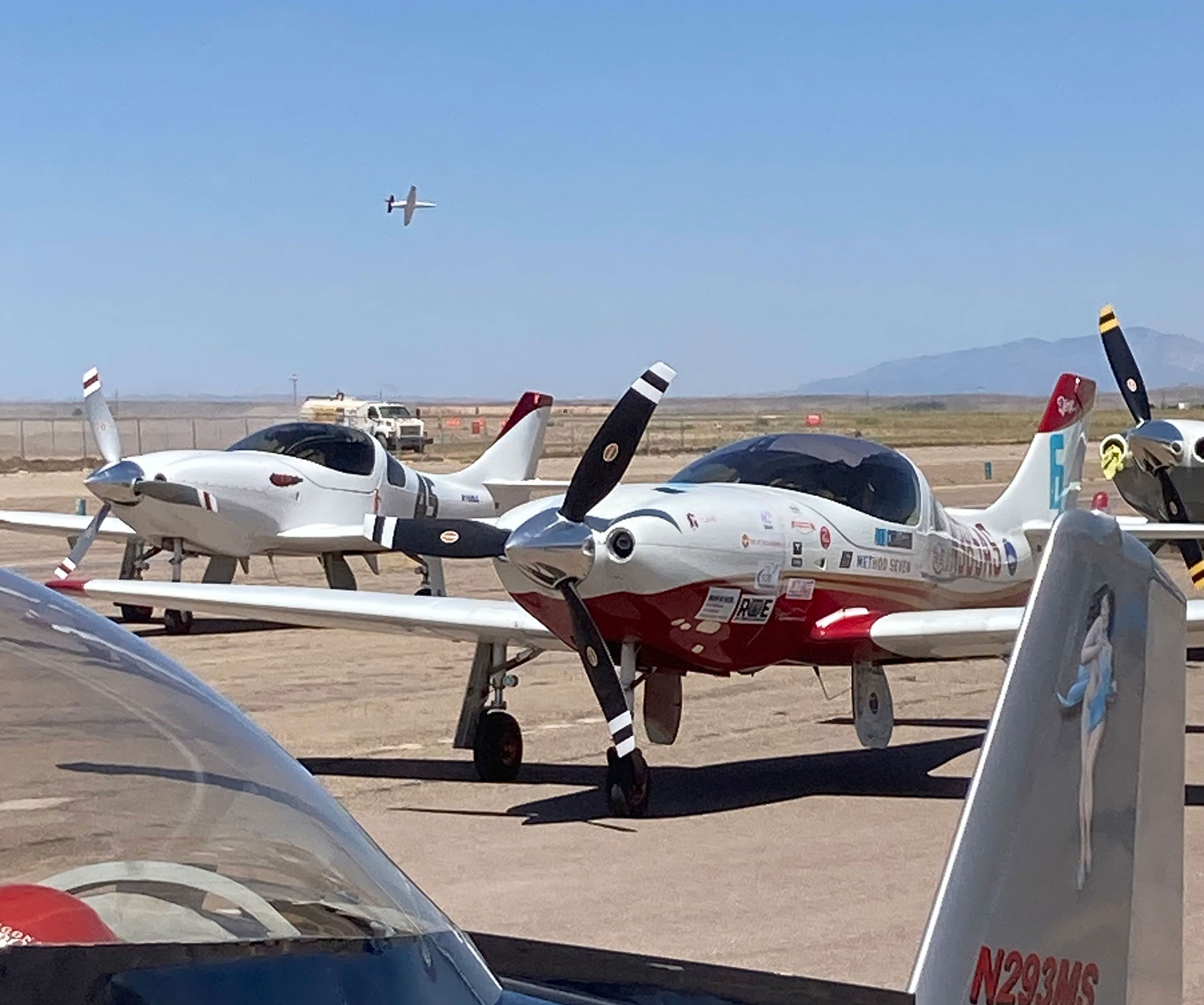
It turns out the Unlimited class wasn’t excited by the long, expensive flight to Roswell, and arrangements have now been made for a mini PRS immediately prior to the races next September. Thus, not a single Unlimited can be found at Roswell this week. The showing of approximately seven Formula 1s, six Biplanes, about four T-6s, and a handful of Jets is distinctly sparse compared to a full racing field.
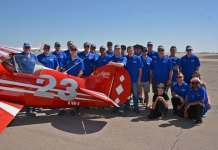
The Sport class is best represented—we counted 22 of them this morning—because they held their own Pylon Racing Training Camp in nearby Las Cruces, New Mexico, just before hopping up to PRS at Roswell.
Don’t let the relatively small number of planes at Roswell fool you. It’s the pilot, not the airplane, being accredited at PRS, so more than a few airplanes have multiple pilots. Three pilots per airplane is not uncommon.
Tuesday and Wednesday, the weather has been cooperative, with modest air temps warding off Roswell’s blazing infrared high desert sun. But this is a first, as only two flights were flown in the previous three days due to high winds and IMC levels of dust. Spring winds are notorious around Roswell, but usually not as strong or long-lasting, say the locals. September weather is typically warm, dry, and not windy.

We’re here mainly for orientation, because the first time to a new racing venue is almost always a throwaway—you spend so much time parking, finding credentials, and figuring out where everyone is camped. There’s also forecasting what the fan experience might be like in September, along with checking in on what’s new with the racers.
We’re doing okay with the logistics, but judging the fan experience is proving difficult, as the new grandstands and other amenities are still under construction. Furthermore, the working pits and hangars at PRS are in Roswell’s existing airside infrastructure, while new spectator areas are being paved or grandstands built. So we and the crews are a zip code or two away from the on-course flying for now. Spectators, participants, and the racing will be closer for the actual races in September.
It does stretch the imagination to think an airport as large as an ex-SAC base—where B-36s and B-52s used to roam—would require any more paving to accommodate some sport planes and a few old fighters, but earth movers are at work as this is being written.
Already paved is an expansive pit area—it’s said all racing aircraft will fit in this new rectangle of asphalt acreage. There will also be immense areas for all sorts of displays, parking, and spectating. Roswell promises the full big-airport, big-show ambiance. Bring your hiking boots.
We can say the fans will mainly have the sun at their backs—great for viewing and photography—but count on being a few more feet back from the racing line. Actually, judging distance at Roswell is near impossible because of the miles of open, flat terrain. The pyramids at Giza could be 15 miles away and you’d think they were at the end of the grandstands. There are no hills in the background to judge speed against, either.
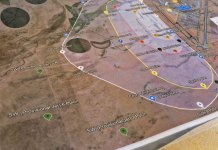
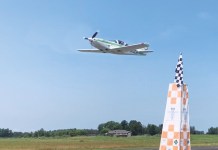
Speaking of distances, the Roswell courses are longer than what everyone was used to at Reno. The Reno Air Racing Association (RARA) has installed an outer course for Jets and Unlimiteds a bit over 10 miles per lap, for example, and even the Sports have 7.8 miles to play with. The larger courses are more D-shaped, giving long straights that could be wings-level for a few seconds for the fast movers.
On the motel front, the chatter in the pits is not good. Still, in spite of rumors to the contrary, we had no issues getting a motel room for PRS at the last minute. But others with long-range reservations for the September races say motels have canceled those reservations to take advantage of “event pricing.” Others have said their rooms were, um, undesirable—in the manner of old and dirty accommodations common in a secondary market. In our experience, Roswell’s motels range from nice to “Not staying here”—hardly different than anywhere else. While our polling is hardly comprehensive or scientific, our advice is to plan on making the NCAR a motorhome or other sort of recreational vehicle event. This also takes advantage of avoiding airshow traffic and remaining on-site for after-hour events and socializing.
One camping detail is the RV parking is not on the expansive concrete ramps, but in open areas between the old Air Force base’s buildings. Roswell is also an airliner boneyard, so a fair bit of the ramp is aluminum shaded.
As someone here said, “Yeah, they need to make this like Oshkosh, where everyone stays at the field.”
In total, the Roswell races are a huge investment on a grand scale. Many millions of dollars have been given by the State of New Mexico, and you can see it in the heavy equipment scooping and spreading dirt. Of course, every last detail is not worked out yet, but RARA is working on it, and certainly a big air race can be run at this airport. For sure, the PRS activities have been going smoothly, and the racers—some of whom have had serious questions regarding course details and obstructions—are putting in laps and giving their input.
One example of something to take care of is a small forest of power poles on the inside of the course. The jet jockeys might not be too worried about these, but the biplanes are flying at 100 feet to avoid the wires on the backside of the course and talking with RARA about what can be done by September.
In the meantime, we’re making our plans for attending the National Championship Air Races this September. See you there.