![A SubSonex personal jet in aerobatic flight. Thea design will expand with a two-place model kit in the months ahead. [Credit: Sonex Aircraft]](https://www.kitplanes.com/wp-content/uploads/2026/08/SubSonex_Acro.jpg?resize=1024,682)
On the last Friday in March, Mark Schaible sat down in front of a camera at the Sonex factory in Oshkosh and told the homebuilt world that Sonex was closing. There would be no graceful wind-down. An emotional video, a written notice, and a brief, unsparing description of the financial reality that had backed the company into a corner — a “perfect storm” of falling sales, rising costs, used Sonex airplanes competing with new kits, and a bank that was no longer willing to carry the debt. Schaible said he and his wife would be filing personal bankruptcy alongside the company. For the roughly 700 Sonex, Waiex, and Onex pilots already flying, and the nearly 1,400 builders still working on kits in their garages, the announcement was like a sudden engine failure in flight. Abruptly and without warning, the lights went out at Sonex. On the first day of May, the lights came back on.
ON Capital, Inc. — which Stephen Osborne later clarified on the Airplane Geeks podcast stands for “Osborne Nelson Capital Group” — acquired all the assets of Sonex LLC. The airframes, the AeroConversions engine line, the Sonex Aerospace work, the tooling, the molds, the order book, and the building itself. They closed, recapitalized, and reopened the doors. By the time most of us had digested the closure announcement, the new company — now operating as Sonex Aviation — was already shipping tail kits.
That is an absurd timeline. Aviation deals do not happen in three weeks. Asset purchases of a manufacturer with customer deposits, supplier obligations, and a half-finished new airplane on the floor are usually measured in quarters. Osborne, in his own words, said his team “moved at extraordinary speed because they had to.” Watching it from the outside, that is exactly the right description. Sonex did not have the option to wait for a tidy due-diligence cycle. Someone was going to either move fast or watch the brand evaporate into bankruptcy court along with the customer deposits and the High Wing program.
Osborne moved fast. The questions now are what has he bought, and do the people who put money down on a Sonex have reason to be optimistic?
A Buyer Who Already Speaks the Language
The most reassuring thing about this acquisition is who is doing the acquiring. Stephen Osborne is not a typical private-equity Mergers and Acquisitions deal maker looking to flip a brand. He is a lifetime EAA member, a third-generation pilot, a warbird operator, holds a commercial pilot certificate, and is a military veteran. He owns The Osborne Co., a general contracting business in Topeka, and Top Aviation Services, a flight school at the same airport. ON Capital, as he described it on the podcast, is “a collection of individuals who just love aviation. We love the trades businesses. And so, what we did is formed a holding group with the sole purpose of collecting organizations like Sonex and get those — if I may use the corporate term for a moment — get those synergies together here.”
Read that again: “vertically integrate” not “extract value.” Osborne told podcaster David Vanderhoof his team is bringing in their own mill shop — the same shop that was already Sonex’s largest outside parts supplier. “The goal there is to vertically integrate, keep the cost down, keep the quality high, keep our production cycle going,” Osborne said.
He is also already telegraphing the next financial chapter. “Sometime in the next year or two, we’ll be looking at bringing on outside investors,” Osborne said. “So people who are interested in joining in on the Sonex legacy — if they want to purchase an airplane or a kit, great. If they just want to be a capital investor, we’re going to have that opportunity as well.” The statement suggests that ON Capital intends to grow Sonex Aviation into something that can support outside capital, which means there has to be a validated product roadmap behind it.
Equally reassuring: this was structured as an asset purchase, and the new ownership has assumed the customer deposits. That is not how most distressed-asset deals work. In a typical bankruptcy fire sale, the deposits get washed out, the new owner walks in clean, and customers with money on the books become unsecured creditors fighting with secured creditors over what’s left. Osborne explicitly said the deposits came along with the assets. “To every customer with a deposit on the books,” he wrote in the May 1 announcement, “get your shop space ready. We are open, we are building, and your kit is coming.”
John Monnett, the founder of Sonex — a name that has long been synonymous with experimental aviation—issued a public endorsement of the new chapter.
“Stephen’s team has the capital, the conviction, and the love of flight to take Sonex further than it has ever been,” Monnett said. “I’m proud to support this team going forward.” In a community where founders’ opinions still carry real weight, that endorsement signals that the people closest to the original mission believe the new ownership understands what they are stepping into.
SONEX: 35 DAYS FROM DARK TO DAYLIGHT
March 27, 2026 — Owner Mark Schaible posts an emotional video message announcing Sonex LLC is closing its doors effective immediately, citing declining sales, rising costs, used-kit competition, and a bank unwilling to extend further credit. He and his wife plan to file personal bankruptcy alongside the company.
April 2, 2026 — Schaible reports “overwhelming” inquiries from parties interested in supporting the fleet or acquiring the company. Founder John Monnett joins the search for a buyer.
Early April 2026 — Stephen Osborne and the ON Capital team begin what Osborne later calls “21 days of sleepless nights” — assembling attorneys, structuring an asset purchase, and racing to close before bankruptcy proceedings can dissolve the company.
May 1, 2026 — ON Capital, Inc., led by Stephen Osborne, closes the acquisition of all Sonex LLC assets — including the Sonex Aerospace and AeroConversions product lines — and reopens the factory in Oshkosh as Sonex Aviation. Customer deposits are honored. Mark Schaible is repositioned as Lead Designer. John Monnett publicly endorses the revival plan.
May 2026 — Tail-kit shipments to High Wing customers resume.
Mid-Summer 2026 — Full High Wing kits expected to begin shipping; factory targeted to reach full production “within the next few weeks” of reopening.
Mark Schaible Lead Designer
The other notable structural decision in this revival is what became of Mark Schaible. Rather than parting ways with the outgoing owner — a move that would have been understandable and, frankly, expected — Osborne kept him on as Lead Designer of Sonex Aviation. The press release described it as Schaible being “elevated and repositioned,” freed from the burdens of day-to-day administration to focus on what he does best: designing airplanes, refining kits, and supporting builders.
That sentence in the release — “the drafting table has its master back full-time” — is the kind of corporate phrase that usually makes my eyes roll, but in this case, I think it is closer to true. Schaible himself laid out the new job description on the same podcast: “I’ll be 100 percent focused on working on finishing the High Wing, getting it done, getting it kitted, getting it out the door. We have some things to do with flight tests and more flight test activities and static load testing of the wing. We’ll be pushing really hard to get that assembly done and tested here very soon. And then more airplanes to come after that.”
That is the right job description for the engineering continuity between the Monnett era and whatever comes next. Pulling him out of the CEO’s chair and putting him back at the drafting table is the right move for the airplane, even if it must have been a bittersweet transition for him personally. Builders who already have airplanes flying — and the ones in the middle of constructing them — have every reason to want Schaible focused on metal and aerodynamics rather than on the complexities of aviation OEM finance.
That kind of leadership split — operator on one side, designer on the other — is how the best small kit companies have always worked. It is how Van’s functioned for years. It is how Sonex itself worked when Monnett ran the design side and others managed the business. Going back to that model after a brush with bankruptcy is a positive course correction.
The High Wing Is a Real Airplane
The shiny new thing on the Sonex order book — and the airplane that probably matters most to this revival — is the Sonex High Wing. It first flew at Oshkosh in June 2025 in the hands of Sonex advisory-board member Joe Norris, started shipping tail kits in January 2026, and was sitting on 80 pre-orders when the crisis hit in March. Those 80 deposits are now in the new company’s hands, with tail kits resuming in May and — per FLYING’s June 12 follow-up — full kits now targeted to begin shipping in late July, conveniently timed against AirVenture 2026.
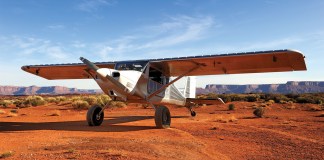
For readers who have not been tracking the program, the High Wing is not a backcountry tundra plane dressed up as a Sonex. (I made this error in perception when I first saw it.) The High Wing is, in the company’s own words, an attempt to translate “legendary Sonex performance and handling” into a high-wing layout. Two seats, cantilevered wing, 6061-T6 aluminum primary structure, 64-415 airfoil, 26-foot 2-inch wing span (with interchangeable shorter wing tips for an aerobatic configuration), 19 feet 3.5 inches long, and a 42-inch-wide interior cockpit. The supported engine menu covers a sensible range of homebuilt powerplants between 100 and 130 horsepower: AeroVee (turbo), Jabiru 3300, UL Power, and the Rotax 9-series.
The published performance numbers are the kind that get attention in the MOSAIC era. Vso of 46 mph at full flaps. Design cruise of 159 mph. Vne of 200 mph. Useful load of 680 pounds in utility category, with a 1,500-pound gross weight. The prototype has been observed cruising at 150 mph indicated and 160 mph true at 2,500 feet on a UL350iS that is not yet pitched optimally, with climb performance of 1,475 fpm solo on aerobatic-configuration wing tips. The factory has said true airspeeds at 8,000 feet “should be outstanding” once the prop is dialed in. Even on early-flight-test numbers, the airplane is firmly within the proposed MOSAIC sport-pilot envelope, which is clearly where Sonex is aiming it.
Pricing, as of last summer’s order book: $500 for a kit reservation deposit, $2,250 for the tail kit, $39,000 for the complete airframe kit, $55,000 for the Quick Build, with a $1,250 tri-gear option. Schaible has signaled “very minor price increases on kits later in the summer” but added, characteristically, “we don’t really want to rock the boat right now. We just want to make product.” These are real numbers — money on the books, hardware on shelves, customers with shop space cleared. The High Wing is not vaporware. It is a product mid-production.
Status as we go to press: static load testing of the wing was scheduled to begin the week of June 15, with completion targeted one to two weeks later. Tail kits are shipping. Wing kits are next in the queue, fuselage kits are slated for fall, and the full Complete Airframe Kit deliveries are aimed at late July. If those dates hold — and that is the right hedge — the first builders will be wheeling High Wing kits into their shops within weeks of this issue landing in your mailbox.
A 90-Day Reset, Then the Roadmap
Osborne has been refreshingly specific about what he is doing inside the building. “A lot of this is just the next 90 days,” he said on the podcast. “We just need to get through the next 90 days. We’re working on automating a lot of our systems. There’s just antiquated inventory and accounting systems, so we’re deploying the resources to make that a much smoother process. If somebody’s ordering something online, it will automatically update our inventory control, so we know what parts to forecast and purchase. Backlogs — that will be a bad word around here. We don’t want that. If somebody orders a part and they need it, we want to be able to ship it the same or the next day.”
That is not a simple goal. It is exactly the kind of goal a kit manufacturer needs. Anyone who has ordered parts from a small homebuilt-industry supplier in the last five years knows the rhythm: a phone call, a promise of “next week,” and then a month of silence. Osborne is essentially promising to put a modern ERP system behind a 1990s-era kit company. If he pulls it off — even partially — it will change the customer experience more than anything else.
After the 90-day reset, the product roadmap. “We have a lot of aspirations for these aircraft,” Osborne said. “Definitely going to see some more production on the Sonex High Wing — we’ll have a lot of opportunities there. The more I look at that airplane, the more impressed I am … We’re also expecting to see a lot of development in the SubSonex jet two-place. So that will be something coming very soon. Very excited about the two-place jet.” Translation: the High Wing carries the near-term revenue. The two-seat SubSonex carries the next R&D chapter.
The Other Airplane on the Roadmap: The Two-Seat SubSonex
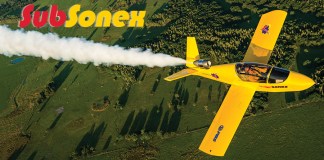
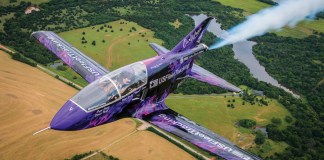
When Stephen Osborne told the Airplane Geeks podcast he was “very excited about the two-place jet,” he was talking about the SubSonex JSX-2T — the side-by-side, two-seat version of the SubSonex Personal Jet that Sonex has been chasing across the show circuit since 2019.
The pitch is straightforward: take the single-seat JSX-2, widen it into a 42-inch side-by-side cockpit, and offer the homebuilt world what Sonex has unblushingly called “the lowest cost jet trainer ever.” Target completed price is under $140,000. Power is the same PBS TJ-100 turbojet — 247 pounds of thrust, 43 pounds of engine — that drives the single-seater, with an optional, more powerful PBS TJ-150 on the menu.
Estimated numbers from the factory: 21’9.6″ wingspan, 18’7.75″ length, 530-pound empty weight, 1,500-pound gross, 970-pound useful load, 50-gallon fuel capacity, 65-mph stall, 200+ mph cruise, and a 275-mph Vne. Outboard wing panels come off for trailering down to a 7’6” footprint — pure Sonex thinking.
The JSX-2T has had a long road. First announced in July 2019. Mockup at AirVenture. A redesign that lowered the turtledeck and canopy bow by several inches after public feedback. Deposits opened in 2022 ($15,000 to reserve a kit). Flight test was originally targeted for early 2023 with kit deliveries by the end of that year. Like a lot of programs in the post-2020 supply chain, it slipped.
What is different now is that the JSX-2T is no longer competing for attention with a financially stressed kit company. Under ON Capital, Schaible is back at the drafting table full-time, the High Wing is moving toward customer deliveries in late July, and Osborne has publicly flagged the two-seat jet as the next major R&D push. Translation: once the High Wing line is humming, the engineering bandwidth — and the cash flow — should be there to actually finish the JSX-2T.
For builders sitting on a SubSonex deposit, or for the pilots who have been quietly hoping for an affordable two-seat jet kit, this is the most credible signal in years that the JSX-2T is really coming. We will keep you posted.
What This Tells Us About the Kit Industry
There is a temptation, when a company nearly disappears and then comes back, to read the whole episode as a feel-good story about the resilience of homebuilt aviation. Some of that is true. The speed of the rescue, the bona fides of the white knight, the founder’s endorsement, the customer deposits being honored — those are genuinely encouraging signs.
But the reasons Sonex closed in the first place have not gone away. Schaible was candid about them in March: declining sales, rising costs, used kits competing with new kits, and bank impatience. Those are structural pressures, not Sonex-specific failures. Every small kit manufacturer in this country is staring at the same headwinds — a smaller pool of working-age builders than we had twenty years ago, a healthy used market that lets buyers skip the four-year build, certified aircraft prices that are nudging some shoppers back into factory-built airplanes, and supply costs that have not come back down since 2021.
What Osborne is betting on — and what we should all be watching — is whether vertical integration, modern systems, and an active R&D program can change the math. The new owners have promised “significant investment in advanced R&D” and “accelerated product development.” If they execute on that, and if MOSAIC opens the LSA market as it most surely will, the High Wing arrives at exactly the right moment, with a two-seat personal jet behind it. If the execution falls short — if “advanced R&D” turns out to be marketing language for a slightly refreshed brochure — Sonex Aviation will face the same wall Sonex LLC hit in March.
For now, the right posture is cautiously optimistic. The kits are shipping. The deposits are being honored. The designer is back at the drafting table. The founder has signed on publicly. Late July should have put High Wing kits at builders’ doors by the time you read this.
If you are sitting on a deposit, by all means get your shop space ready. If you have been thinking about a Sonex — particularly the High Wing — there is now a factory in operation again. And if you are watching this from the outside, take it as a reminder of what this industry is: a tight, stubborn community where the line between customer, supplier, designer, and rescuer can vanish in a few weeks when it has to.
Sonex got a second life because a third-generation pilot in Kansas refused to let it disappear, and because the people inside the company — Schaible included — refused to walk away from the airplane they had been building. That is a homebuilt story, end to end. We will be watching closely from here, and we will be back to report on whether the late-July kit deliveries, the wing static-load test, the SubSonex jet program, and the new R&D commitments live up to the press release.
For now, though, the lights are on in Oshkosh. Crews are working. Kits are moving. And eighty customers have very good reasons to clear out the shop.
This article first appeared in the 2026 August Issue of KITPLANES magazine.
![The alternative to bending down as the propeller is pulled through the compression stroke is to keep the back straight and bend the knees slightly, stepping away in a crouch. [Credit: LeRoy Cook]](https://www.kitplanes.com/wp-content/uploads/2026/05/IMG_1519-scaled.jpg?w=218&h=150&crop=1 "Manual Starting Methods")
![[Credit: JetStream Rider]](https://www.kitplanes.com/wp-content/uploads/2026/04/AdobeStock_345999332.jpg?w=218&h=150&crop=1 "2026 Avionics and Lights Buyer’s Guide")