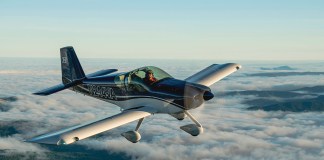
![Pat McKiernan has found that he and his dad who built this beautiful RV-7 simply learned to enjoy the build. [Credit: Bill Wilson]](https://www.kitplanes.com/wp-content/uploads/2026/08/Builder.jpg?resize=1024,682)
People begin building aircraft for many reasons. Some dream of flight in an airplane they assembled with their own hands. Others are attracted by the challenge, the craftsmanship, or the opportunity to create something truly unique. Most expect that the reward will come on the day the wheels leave the runway for the first time.
What many builders discover, however, is that the airplane is only part of the project.
Along the way, aircraft construction teaches lessons that reach far beyond the workshop. The skills, attitudes, and habits developed during the building process often become some of the most valuable products of the entire experience.
One of the first lessons builders learn is patience. Modern life rewards speed, shortcuts, and immediate results. Aircraft construction rewards none of them. Good builders learn to slow down, think through problems, verify assumptions, and sometimes walk away for the evening rather than force a mistake. The workshop becomes an unlikely classroom for developing judgment and self-discipline.
Building also teaches confidence, but not the kind that comes from motivational slogans. It is confidence earned through accomplishment. Thousands of individual decisions eventually become a completed aircraft. The builder gains proof that large challenges can be overcome one small task at a time. That realization tends to carry over into every other area of life.
Perhaps one of the most surprising discoveries is how much building depends on other people.
Ed Hefner came away from the experience with a simple but powerful realization: “No man is an island.” That lesson became especially clear while finishing his Sling TSi at the builder-assist center. Like many builders, Ed found himself surrounded by people willing to share knowledge, lend a hand, offer encouragement, or provide solutions to problems they had already encountered themselves.
Aircraft building has a way of dismantling the illusion of complete self-sufficiency. Builders learn that independence and cooperation are not opposites. In fact, the most successful projects often depend upon communities of knowledge, mentorship, and shared experience. The friendships formed during the process frequently last far longer than the project itself.
Another unexpected lesson is that the human capacity for learning is far greater than most people imagine.
Many first-time builders begin convinced they lack the skills necessary to complete an aircraft. Yet over time, wiring diagrams become understandable, construction techniques become familiar, and once-intimidating tasks become routine. The experience demonstrates that there is plenty of room in our expanding brains to accept new information and process it.
Aircraft building quietly disproves the notion that learning belongs only to the young. Instead, it reveals that curiosity, persistence, and purpose remain powerful teachers throughout life. Builders discover that expertise is rarely magic. More often, it is simply the result of patience, repetition, and a willingness to keep learning.
For Skyranger Nynja builder Dale Seitzer, the project raised a different question altogether.
“Am I a flyer or a builder?”
It is a question nearly every builder-pilot eventually confronts.
Some are drawn primarily to the freedom of flight. Others find deep satisfaction in the process of creating the machine itself. Dale successfully answered the question by realizing he was both—just not at the same time.
There were seasons when the builder had to come first. Flying took a back seat to fabrication, planning, troubleshooting, and learning. Eventually, the balance shifted and the flyer returned, now operating an aircraft he understood at a much deeper level because he had built it himself.
Dale’s experience highlights an important truth. Meaningful accomplishments often require us to move between different roles at different times. We must be creators before we can be operators, students before experts, and builders before flyers.
For Zenith CH750 builder Tia Robbins, the greatest lesson was deceptively simple.
Slow down and pay attention to detail.
Aircraft construction teaches that precision is not obsession—it is responsibility. Every builder eventually learns that rushing rarely saves time. A hurried measurement becomes a replacement part. An overlooked detail becomes rework. The project rewards careful inspection, thoughtful pacing, and full attention to the task at hand.
That lesson extends naturally into everyday life. Builders begin noticing details they once overlooked and become more deliberate in their decision-making. They learn that slowing down is not falling behind. More often than not, it is the fastest way to get things right.
![Patience, perseverance needed to overcome obstacles work best. [Credit: Bill Wilson]](https://www.kitplanes.com/wp-content/uploads/2026/08/unnamed-1.jpg?resize=1024,682)
Pat McKiernan and his father, builders of one of the most beautiful RV-7s flying today, discovered yet another benefit of aircraft construction.
They learned to enjoy the build.
Many builders begin with their eyes fixed firmly on first flight. Completion becomes the goal, and every task is viewed merely as a step toward that destination. Yet somewhere along the way, many experience a subtle shift. The workshop stops being a place to finish an airplane and becomes a place they genuinely enjoy spending time.
The reward begins arriving long before the aircraft is complete.
For family projects especially, the value often extends beyond the airplane itself. Fathers and sons, spouses, friends, and partners build more than aircraft. They build memories, traditions, and relationships. Years later, many builders remember the people they worked alongside as vividly as they remember the airplane.
Howard Tetrault’s RV-10 project offers another lesson.
Howard has spent years working toward completion of an airplane that many observers would consider mostly complete. He jokingly describes the project as being in the familiar homebuilder phase of “90 percent complete with 90 percent left to go.”
Part of the reason is Howard’s vision for the aircraft. His RV-10 will incorporate an extensive collection of electronic systems designed to enhance both safety and capability. Integrating those systems requires extraordinary patience, planning, and precision.
The process has taught Howard something important about overcoming obstacles.
Every builder eventually encounters problems that seem larger than the task itself. Components refuse to cooperate. Wiring issues consume days. Solutions create new challenges. Yet successful builders learn that obstacles are not signs that progress has stopped. More often, they are the means through which progress occurs.
The discipline required to work through one challenge after another develops resilience and confidence. Builders discover that success is rarely the result of avoiding problems. It is the result of learning how to solve them.
Taken together, these lessons reveal something remarkable about aircraft construction.
The airplane may be the intended product, but it is seldom the only one.
Builders emerge with greater patience, stronger problem-solving skills, increased confidence, improved attention to detail, deeper friendships, and a renewed appreciation for lifelong learning. They learn to persevere through obstacles, enjoy the journey as much as the destination, and understand that worthwhile accomplishments are achieved one careful step at a time.
When the day finally arrives and the aircraft lifts off for its first flight, the builder has accomplished something extraordinary.
But the most enduring achievement may not be the machine climbing into the sky.
It may be the person who was built along the way.
This article first appeared in the 2026 August Issue of KITPLANES magazine.
![At Sun ‘n Fun 2026, Viking Aircraft Engines surprised the crowd with its first complete kit — the V-42, a high-wing twin powered by two Honda-based engines. Here’s an early look. [Credit: Andrew Robinson]](https://www.kitplanes.com/wp-content/uploads/2026/08/P1020293.jpg?w=324&h=160&crop=1 "Viking V-42 Twin")