
During the golden age of U.S. General Aviation, the definition of which varies with the presenter but can be described as the 50 years from 1960 to 2010, there were a lot of proposed, prototype or production airplanes that suffered stillbirth or infant mortality, deservedly so, in some cases. In others, failure was a result of bad timing or an unfounded adverse reputation. I was around for most of these poorly received introductions, and I even flew some of them. For the readers’ edification, I’d like to dredge up my recollections of some almost-made-it concepts. If nothing else, it might bring a bit of historical reality to the creations being promoted in the current Urban Air Mobility fervor.
Big C’s Mistakes
Cessna Aircraft Company blossomed mightily in that gilded age of imaginative concepts; some blooms, alas, faded despite best efforts to cultivate their planting. One was Cessna’s flirtation with the Skyhook helicopter in 1961, quickly abandoned despite apparently good performance. Another was the one and only four-engine pressurized Model 620, a would-be business airliner built and flown in 1956, as a sort of super-sized Cessna 310. A more successful but still short-lived aircraft, placed in production in 1958, was the company’s first attempt to fill the gap between the 172 and 182. The model 175 failed to overcome suspicion of its geared GO-300 powerplant, despite five years of promotion.
On Cessna’s twin-engine side, its first cabin-class twin, the model 411, came out in 1965 with a stylish, but insufficient, swept vertical fin, and was almost-immediately taken out of production, perhaps more due to the success of the pressurized 421 of 1967 than its poor service record. The 401/402 dual-purpose twins replaced it in the 1967 line-up, using the 421’s bigger tail. The 401 was supposed to be an executive-interior plane, with the 402 having a changeable cargo/people cabin for charter work. The 401 disappeared after six years, in favor of the 402’s wider loading range that kept it going into the mid-80s.
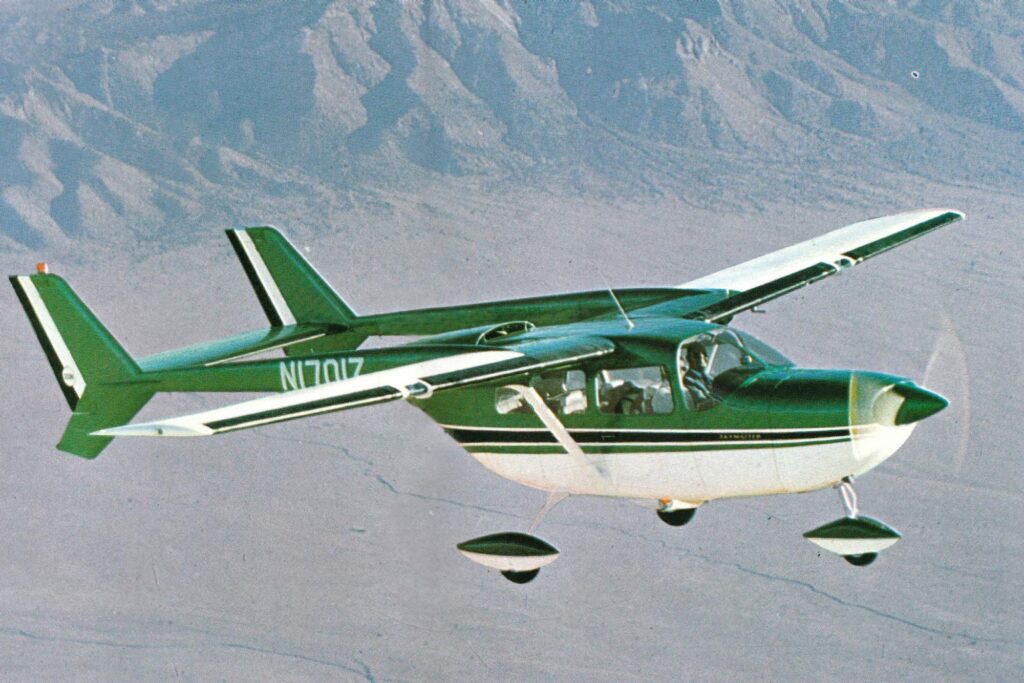
Cessna’s twin-engine centerline-thrust Skymaster 337 series, produced from 1965 to 1980, almost didn’t succeed, starting out as a simpler fixed-gear 336 that was built in 1963 and 1964. Only 195 of the 336’s were sold. Skymaster buyers eventually responded to the sleeker look of the gear-up 337, introduced in 1965, but it was a near escape.
The light-sport airplane fever in the early 2000’s resulted in Cessna fielding a Chinese-built Skycatcher 162 in 2009, which turned out to be too late and too heavy for its saturated market. Five years of effort couldn’t succeed against sleeker composite LSA’s from across the other ocean.
Brand P’s Faux Pas
Piper Aircraft countered with a Czech-built PiperSport LSA in 2010, before wisely giving up its light sport marketing plans the following year. Piper had also garnered its share of non-starters over the years, like the 1962 fiberglass/plastic Papoose two-seater, of which only one was built. The more conventional Tomahawk trainer had a five-year production life from 1978 to 1982, despite an ill-deserved bad reputation early on.
In 1968, Piper flew a hulking PA-35 Pocono commuter airliner with 18 seats, powered by a pair of eight-cylinder TIO-720 Lycoming engines; only the prototype was made. Piper also built a one-off Pressurized Aztec in 1974, but the product line already had the P-Navajo, so it was never put into production. There was a tri-motor Cherokee with a engine on each wing plus the original nose-motor, and a turboprop version of the Comanche 400 with a Garrett TPE-331 up front.
Piper also made attempts to make an Enforcer counter-insurgency turboprop anti-tank and light attack airplane, first with a modified P-51 Mustang in the early 1970s, and then an entirely new Enforcer in the early 1980s. Neither gained USAF favor.
![Both Piper and Cessna made attempts to capitalize on the multiengine cabin class market in the 1960s. [Credit: Piper Aircraft]](https://www.kitplanes.com/wp-content/uploads/2026/03/piper-pocono-1024x683.jpg)
Beechcraft’s Might-Haves
Beech Aircraft had also a few non-achievements along the way, like the mocked-up concept of a large Model 120 turboprop that was shown in 1962. It was abandoned in favor of the 1964 King Air, which was a far simpler outgrowth of the Queen Air. The 1982 Lightning single-engine turboprop would have married a pressurized Baron fuselage with a King Air engine, but it was canceled after its projected price exceeded the $1 million that was considered the limit of salability.
A T-tail Bonanza 36 concept was flown, perhaps being considered for pressurization, but only one was made, circa 1979. And a jet-powered Super King 200 was flown with Pratt & Whitney JT-15D engines in 1975, but it never went forward to production. Four decades earlier, in 1955, the T-34 Mentor military trainer had been given jet power as a proposed Jet Mentor but was rejected by the USAF in favor of Cessna’s T-37; the turboprop T-34C had much more success as a Navy trainer, built from 1975 to 1982.
![Mooney Aircraft was always eager to innovate and tried out some very interesting concepts. Some worked, some didn’t. [Credit: Mooney Aircraft]](https://www.kitplanes.com/wp-content/uploads/2026/03/Mark22Mooney-1024x682.jpg)
Sadly, Beech’s all-composite Starship canard-turboprop program turned out to be less than a runaway marketing revolution. Envisioned as an avant-garde advancement over the King Air 200, the Starship’s 85% scale POC testbed flew in 1983, but it took until 1990 for the full-scale Starship to enter the market, by which time the King Air 350 was doing Starship’s job in a cheaper, more-conservative manner. Only 50 production Starships were built.
Mooney Aircraft, always eager to innovate, tried out such concepts as a wood-wing Mark 22 twin in 1958, which was never put into production. From 1967 to 1970, Mooney actually produced the more well-known Mark 22 Mustang pressurized single, but it turned out to be an economic disaster for the company. In 1988, Mooney fielded the M20L PFM, powered with a Porsche six-cylinder engine; only 41 were built, but its longer fuselage, needed for balance with the lightweight Flugmotern, served well later on for the big-block M20R and M20S models.
Rockwell Corporation likewise stubbornly tried to develop airplanes to suit every market niche, from ag planes to jets, not all of which succeeded. In 1978, it diversified in collaboration with Fuji to sell a Commander 700 low-wing cabin-class piston twin, which was not a huge success with only 32 built. Earlier, it had acquired the rights to the sleek Meyers 200 high-performance single, marketed during the mid-1960s as the Commander 200, along with the boxy Commander 100 fixed gear single it had bought from Volaire. After being dropped by Rockwell in favor of fresh in-house designs, the Commanders 112 and 114, the Meyers/Commander 200 was converted to turboprop power as the Interceptor 400 pressurized four-seater, a too-early aircraft that never found backing for production.
Other companies had non-achievers as well. Bellanca built an Aries T-250 all-metal new-generation single in 1977 that wasn’t able to be produced, Maule put an Allison turboprop in its utility tailwheel plane in the 90s, but found few sales, and Grumman-American briefly fielded a GA-7 Cougar twin in the late 70s that showed much promise before the company exited lightplane aviation entirely.
In a strong market like general aviation enjoyed in the 1970s, it was natural to expend much effort on research and development, even though not all attempts to advance the art saw success. But, for us industry observers at the time, it was certainly fun to watch general aviation companies try…
![[Credit: AdobeStock]](https://www.kitplanes.com/wp-content/uploads/2026/05/AdobeStock_262642207_AGCuesta.jpg?w=218&h=150&crop=1 "Winging It")
![The original Corben Baby Ace designed by Orland “Ace” Corben in 1929. [Credit: Wikimedia Commons]](https://www.kitplanes.com/wp-content/uploads/2026/03/1920px-Ace_Baby_Ace_‘N73638_25617429253-scaled.jpg?w=218&h=150&crop=1 "Vintage Homebuilts: The Big Three")




I really like the Cessna 175B that I’ve been flying….once you know how to run the GO-300. The ‘sweet’ rpm is 2,800 to 3,000 rpm, leaned aggressively !The problem that my A&P and I found is that the oil cooler always has the oil going through it. That results in the oil temp barely reaching 100 degF. causing early cylinder failures.
I found that covering part of the cooler with aluminum tape, I can get the oil temp to 170-180 degF.
Since doing that, the cylinders have 600-1,200 hrs on them and the oil use is 10-12 hrs per qt.
Performance is amazing, initial roc is 1,000 to 1.300 fpm at 90 to100 mph, and cruise is 120-130 mph.
I have 2 STCs, flap gap seals and the Hoerner wing tips..these have lowered the stall speed 10 mph, 50 clean and 40 with 30 deg flaps.
the other amazing result is 2 gph lower fuel use, 6.8 gph at 130 mph.!
So, my engine is onw 1,000 hrs past tbo, and is going strong…no reason to tear down a great running engine.
[ I do borescopes of the valves and cylinders,,,all looks great]
BTW, I started using Alcor TCP to reduce the lead deposits…it works.!!
The GO-300 was a great engine. Its biggest problem was it had to be operated at those high RPMs to keep the cylinders cool. Operators couldn’t bring themselves to do that because they thought they were hurting the engine. As a result the cylinders would crack and that’s how the engine/airplane got a bad, undeserved reputation. Pity, it was a great airplane.
Comments are closed.