![A Zenith STOL CH701 on Zenair amphibious floats rests on a sandbar on the Caribbean island of Guadeloupe. [Credit: Zenith Aircraft]](https://www.kitplanes.com/wp-content/uploads/2026/08/zenair-floats-STOL_CH_701a-Topaz-Gigapixel-2x-scale-Topaz-Gigapixel-2x-scale.jpg?resize=1024,682)
In 1986, a Canadian aeronautical engineer named Chris Heintz pulled the first STOL CH 701 out of a shop with a 50-hp Rotax 503 hanging on the firewall, a steel-tube engine mount that wouldn’t intimidate a first-time builder, and a wing that looked, to the average general-aviation pilot of the era, like somebody had bolted a barn door to a Citabria. There were no STOL Drag events. There was no Valdez. There was no YouTube algorithm pushing seven-second takeoff clips to three million subscribers. There was a draftsman, a slide rule, and an unfashionable conviction that an airplane could be designed to do one thing — get into and out of a short, rough piece of dirt — extremely well, and nothing else especially well at all.
Forty years later, the 701 is still in production at Mexico, Missouri. Sebastien Heintz, Chris’s son, runs the company. The kit has been through enough revisions that match-drilled, final-hole-size parts now ship in the box. Two generations of the Heintz family have refined the design without ever rewriting it. And the airplane that started life as a 50-hp two-seater is, fairly or not, the platform most homebuilders measure backcountry kits against.
That is impressive longevity in a market that has lost more kit designs in the last four decades than it has kept. (Name five 1986-vintage kit airframes still in continuous production from the original manufacturer.)
For the 40th anniversary, the question isn’t whether to throw the airplane a party — Zenith’s June 20 “Fly-In to Summer” and the September 18–19 Zenith Homecoming are already set. What did Chris Heintz get right in 1986, and why have those choices aged so well? Why does the CH701 still attract builders facing a buying decision in 2026?
Form Follows Function — Function Was Always Short Field
The 701 is the rare general aviation airframe where every visible feature on the airplane resolves back to a single design goal. Heintz wasn’t trying to design a fast cross-country machine, or a comfortable tourer, or a trainer that would look good on a flight-school ramp. He sought to build something that would lift off and land in roughly the same airspeed band, control authority intact, with a decent useful load that a pilot wouldn’t need 1,200 hours of tailwheel time to operate.
The wing is an example. Constant chord, all metal, dual strut. Heintz designed it short on span — clearance matters off-airport — and packed it with high-lift devices. Fixed leading-edge slats run the full length of the wing. The trailing edge is given over entirely to Junkers-style flaperons that combine aileron and flap function in a separate airfoil section. The flaperons hang far enough below and behind the wing’s trailing edge that they keep airflow over the control surfaces well into the stall regime — which is why the airplane will give the pilot meaningful roll authority at very low speed. Hoerner tips recover effective span without adding actual span and knock down the tip vortices that would otherwise eat into low-speed lift.
It is worth noting how many of these features have, in the last decade, been retrofitted onto other airplanes. Builders are bolting leading-edge slats onto airframes that didn’t ship with them. They are adding micro VGs to elevators and rudders. They are chasing the slow-flight envelope that the 701 arrived with, because Heintz had thought through the boundary-layer problem before the rest of the market did.
The tail. The horizontal stabilizer is inverted — the high-lift surface oriented to push the tail down rather than hold it up — which gives the airplane rotation authority at the low speeds it moves at on a 200-foot takeoff roll. The vertical surface is all-flying. There is no fixed fin. Fewer parts, more authority per degree of pedal deflection, and crosswind control that handles gusty afternoons you cannot avoid if you fly off airport. The elevator is oversized and is a true airfoil section rather than a flat plane; many owners have modified their airplanes with a row of micro VGs along the leading edge to extend its effectiveness down to the bottom of the speed range.
The fuselage is built like a sheet-metal box: flat sides, with the bottom and tail surfaces swept up sharply enough that the airframe can rotate to a steep deck angle without dragging anything. Flat sides are not a styling decision. They are the reason a first-time builder can square the fuselage with simple hand tools and no jigs. Heintz designed the airframe to be assembled in a two-car garage, without temperature or humidity control, and without a machinist’s skills or tools. The construction method is the design.
![Zenith STOL CH 701 in standard tricycle gear configuration with 100-hp Rotax 912ULS powerplant. [Credit Zenith Aircraft]](https://www.kitplanes.com/wp-content/uploads/2026/08/STOL-CH-701-mexico-Topaz-Gigapixel-2x-scale.jpg?resize=1024,683)
![Zenith floats add versatility to the already very versatile STOL CH 701. The all metal floats simply bolt to the airframe, and are available in straight floats or amphibious. [Credit: Zenith Aircraft]](https://www.kitplanes.com/wp-content/uploads/2026/08/Roost-2-Topaz-Gigapixel-2x-scale.jpg?resize=1024,683)
A Heretical Position on Landing Gear
One of the calls Heintz made in 1986 that didn’t fully come into focus until the last decade was putting the 701 on tricycle gear. The backcountry orthodoxy of the era — and still, in some quarters — was that serious short-field flying required a taildragger. Tailwheels were what the bush pilots flew, and what the bush pilots flew was what you built if you wanted to be taken seriously off airport.
Heintz didn’t agree, and the math has been on his side for forty years.
Three wheels keep the airframe level on the ground, which makes the cabin easier to load, the panel easier to see over while taxiing, and the airplane considerably easier to insure for a low-time pilot. He gave the nose gear a direct rudder-pedal linkage and tough rubber pucks for shock absorption, and he sized all three wheels large enough that the airplane could operate from the kind of unimproved strip the taildragger crowd assumed only their airplanes could use. Pull the stick all the way back on takeoff and the airplane unloads the nose wheel almost immediately. Weight transfers to the mains, and the 701 behaves, for the rest of the takeoff roll, exactly the way a taildragger does. The difference is that the airplane doesn’t sit nose-high on the ground, and the pilot does not S-turn to taxi.
This was a heretical position to take in 1986. It is now, in 2026, the configuration choice that has put 701s into hangars bypilots who never would have committed to a taildragger transition. The insurance differential alone has probably built more 701s than any single Heintz design decision other than the wing itself.
A Kit Designed to Be Built
Heintz designed the 701 to be assembled, not just flown. The kit is all thin 6061-T6 aluminum, blind-riveted throughout. There is no welding required on the airframe. The skins, ribs, spars, and bulkheads are flat-pattern parts that can be laid out, drilled, and pulled together with the kind of simple tools builders already own. Heintz published full blueprints in addition to the kit, which means a builder so inclined can still scratch-build the entire airplane from raw stock — an option that, four decades on, remains on the table.
The most consequential update to the kit since 1986 happened recently and, characteristically for Zenith, quietly: parts and components now ship match drilled. For builders who came up through the original Heintz construction methodology — pilot-drilling, clecoing, fitting, then final-drilling and deburring — this change compresses the build timeline substantially. The pre-match-drilled generation of 701 builders measured first-flight timelines in years. The current generation, with final-size-drilled parts in the box, can measure them in months. That single change has done more for the 701’s accessibility to time-constrained builders than any other improvement to the kit in two decades.
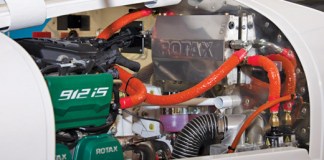
The kit also does something newer designs sometimes don’t: it leaves room for the builder to make decisions. The 701 has been completed with Rotax 912s, Continental O-200s, Jabiru fours, Viking Honda conversions, and the original Rotax 582 two-strokes the early prototypes flew behind. Floats, straight and amphib. Skis, straight and wheel-ski. Folding wings, extended-range tanks, belly pods, camera mounts for the wildlife-survey crowd, vinyl wrap for the builders who don’t want to spray paint in a rented hangar. The sheet-metal construction is forgiving enough that all of this is bolt-on rather than redesign-and-rebuild.
The “Sky Jeep” nickname that owners attached to the airplane somewhere in the late 1990s captures all of it. The 701 is the airplane that goes where you don’t want to drive the car, and the kit is the one you assemble in the same shop where you would rebuild a Jeep transfer case.
What Forty Years Looks Like in 2026
Two pieces of the 701’s current moment are worth highlighting for builders evaluating a 2026 build.
First, the 701 has spawned a family. The four-seat STOL CH 801 grew directly out of the 701’s wing-and-tail philosophy at larger scale. The STOL CH 750 was optimized for the original LSA category — wider cabin, refined cockpit, same Heintz DNA — and has since branched into the CH 750 Cruzer and the CH 750 Super Duty, the kit lineup Zenith leans on most heavily for new builders today. The 701 didn’t just survive. It became the seed of an entire airplane family, and its design vocabulary is still the spine of every airplane on Zenith’s current price list.
Second, MOSAIC, having taken effect on July 24, changes the perspective around the whole Zenith lineup. Under Part 22’s performance-based 61-knot landing configuration stall standard, more Zenith airframes become MOSAIC-eligible LSAs at heavier gross weights than the old 1,320-pound cap allowed. The 701 itself was always slow enough to sit comfortably inside the old envelope; the rule change matters more for the 750 series. But for a sport pilot evaluating a backcountry airplane in the MOSAIC environment, the 701 is one of the few designs that didn’t need the rule to change to make sense. It was designed for the mission, not for the regulation, and it still flies the mission better than airplanes that cost three times what a 701 kit costs.
![Early 2-cycle Rotax engines were popular in the CH701, as well as automotive conversions, such as the VW shown above. [Credit: Zenith Aircraft]](https://www.kitplanes.com/wp-content/uploads/2026/08/wayne-clagg1-6-Topaz-Gigapixel-4x-scale.jpg?resize=1024,682)
![The Zenith STOL CH 701 wing features full span fixed leading edge wing slats (shown in yellow) for maximum high lift. [Credit: Zenith Aircraft]](https://www.kitplanes.com/wp-content/uploads/2026/08/ch701_a2a_10-Topaz-Gigapixel-2x-scale.jpg?resize=1024,682)
The Wairworthy Build
Carson Stilson — who runs the Wairworthy channel on YouTube — is finishing what he describes as a budget CH701 build, with the stated intent of demonstrating how cheaply an entry-level pilot can put the airplane in the air, then giving the finished airplane away to one of his viewers. Sebastien Heintz and Roger Dubbert recently flew a factory video sortie on the same theme. The build is real, the parts are coming off the same Zenith shelves the rest of us order from, and the cost numbers Stilson is publishing in public are exactly the kind of transparency the industry has otherwise been reluctant to offer. (Stay tuned for Carson’s work on the CH701 to appear between the covers of KITPLANES in the months ahead.)
The Through-Line
The lesson of forty years of the Zenith STOL CH 701 isn’t really about a particular airplane. It is about what happens when an engineer designs to a mission, refuses to chase the market, and trusts the builder to assemble what he draws.
Heintz did not design the 701 to be everything. He designed it to be a slow, controllable, affordable, durable, off-airport two-seater that a working adult could build in a garage and a low-time pilot could fly without an insurance penalty. He has been right about that for forty years. The airplane has outlasted the manufacturers and the magazine columnists who told the homebuilt community in 1986 that the 701 was too slow, too ugly, too unconventional, and aimed at too narrow a market to succeed.
There is a temptation, on anniversary stories, to read the whole arc as a feel-good narrative about the resilience of homebuilt aviation. Some of that is true here. But the more useful lesson, for a builder evaluating a kit in 2026, is structural. The 701 worked because Heintz designed for a mission, an assembly method, and a builder profile that he understood as a single problem. He did not design an airplane and then try to figure out who would build it. He designed a kit that a particular kind of person would build, and an airplane that the same person would want to fly when it was done. That alignment is rarer in this industry than the catalog page count suggests, and it is the reason the 701 is still in production while a long list of more sophisticated 1986 designs is not.
Forty years on, the Sky Jeep is still in production, still in builders’ garages from Alaska to New Zealand, and still doing the one thing Chris Heintz designed it to do. That is what a successful kit design looks like over the long haul, and it is why the 701, more than almost any other airframe in the Experimental category, deserves the anniversary it is celebrating this year.
THE 701 AT 40: A DESIGN AUDIT
![[Credit: Zenith Aircraft]](https://www.kitplanes.com/wp-content/uploads/2026/08/qsp2-Topaz-Gigapixel-2x-scale.jpg?resize=1024,682)
First flight: 1986, with a 50-hp Rotax 503.
Designer: Chris Heintz — Canadian aeronautical engineer, founder of Zenair (Canada) and parent of the Zenith Aircraft
Company product line built in Mexico, Missouri.
Construction: All 6061-T6 aluminum, blind-riveted throughout. Flat-sided fuselage. No jigs, no welding, no temperature- or humidity-controlled shop required. Full blueprints published; scratch-building remains an option.
Wing: Constant-chord, dual-strut, short-span high-lift wing. Full-length fixed leading-edge slats. Junkers-style flaperons combining aileron and flap function in a separate trailing airfoil. Hoerner tips. Washout built into the flaperons.
Tail: Inverted horizontal stabilizer (down-loaded for rotation authority). All-flying vertical surface (no fixed fin).
Oversized elevator with a true airfoil section, frequently fitted by owners with micro VGs along the leading edge.
Landing gear: Tricycle, with direct rudder-pedal linkage to the nose wheel and rubber-puck shock absorption. Large wheels on all three corners — “affordable bushwheels,” in Zenith’s own framing.
Cabin 40-inch-wide side-by-side. Dual bubble doors. Centerline “Y” stick. Above-cab tapered wing root for forward and turn visibility.
Cockpit options: Full panel or sport-minimalist. Engine choices include Rotax 912 series, Rotax 582 (legacy two-stroke), Continental O-200, Jabiru 2200, and Viking Honda conversions, among others.
Field options Floats (straight or amphib), skis (straight or wheel-ski), folding wings, extended-range tanks, belly pods, camera mounts.
Design family: STOL CH 701 -> STOL CH 801 (four-seat) -> STOL CH 750 (LSA-optimized) -> CH 750 Cruzer / CH 750 Super Duty.
Recent kit change: All current STOL CH 701 kits now ship with parts match-drilled to final hole size — a meaningful compression worth noting of the traditional Zenith build timeline.
This article first appeared in the 2026 August Issue of KITPLANES magazine.
![A sleek Glasair II. [Credit: Glasair]](https://www.kitplanes.com/wp-content/uploads/2026/08/Glasair-II_2863.jpg?w=218&h=150&crop=1 "Class of ’86: How 1986 Transformed the Modern Kit Building Industry")