
![The 160 hp turbocharged Rotax 916iS is a four-stroke piston engine with redundant electronic fuel injection and ignition. [Credit: BPR Rotax]](https://www.kitplanes.com/wp-content/uploads/2026/05/PIC_916-iS_iSc-2-1024x682.jpg)
When did you realize that your aviation journey would not be complete until you built your own airplane?
Perhaps the need to pull rivets, bend wood, weld steel tubing or stitch fabric has yet to develop fully, but it probably will. Most pilots, at some point, I believe, at least consider taking on the challenge and reaping the benefits of a homebuilt aircraft project.
There are many reasons for doing so, from getting airborne on a budget and the freedom to tailor an aircraft to the pilot’s specific needs, to the straightforward satisfaction of engaging in complex, intense handiwork. The motivation toward building an airplane from a kit and plans is as varied as the types of aircraft available and the personalities of their builders.
There is, however, one critical step in the process at which the diverse paths of all amateur aircraft builders meet: picking engines for their meticulously crafted custom creations.
Supply Chain Update
Ever since the COVID-19 pandemic of 2020, the broader homebuilt aircraft industry and the engine segment specifically have been working through a variety of disruptions stemming from production shutdowns, labor shortages and supply chain shortages that in many cases persisted longer than expected. This year might be the first for which wait times for delivery of certain aircraft engines reliably fall below a full year.
Lycoming, a perennial go-to for amateur builders, worked for years to solve supply difficulties that delayed production of its custom experimental Thunderbolt engines. The company said customers ordering a Thunderbolt today should expect delivery in about 11 months, down from 18 months a year ago and 30 months two years ago.
The company said the change reflects a continued easing of supply-chain strain as well as changes it has made to its operations including adding production equipment and training more engine-building staff. While wait times have improved in general across the industry, they vary widely depending on the manufacturer, the model of engine and custom features the buyer might choose.
While a wait of almost a year might seem long, especially when rival Rotax, also a staple supplier of experimental aircraft engines, can deliver its powerplants within 30 days, the news from Lycoming is encouraging. The trend toward decreased wait times suggests improvement will continue, and a wait of less than 12 months essentially guarantees that engines ordered at the same time as the corresponding kits will arrive by the time builders are ready to install them.
Still, builders need to be aware of any supply issues particular to the engines they are considering for their homebuit projects, and to order accordingly. Lycoming said it continues to advise customers to order their engines as early as possible.
The potential delays and other difficulties with engine delivery that builders should prepare for can range from significant to nonexistent depending on the aircraft they are building.
I have a friend who has been flying his 180 hp Lycoming O-360-powered Van’s RV-8 for more than a decade. Had he just ordered the kit today, he should have already ordered the engine. If his current engine was nearing runout and would soon need replacement, he would need to keep track of engine hours and, to be assured of staying on schedule, order the new engine at least a year before he expected to install it.
Builders of RV-8s and several other Van’s aircraft essentially designed around the O-360 and its derivatives, were among those affected most by Lycoming’s supply-chain woes during the pandemic and in its wake.
Another acquaintance, who built an Airdrome Aeroplanes Fokker E-III, a ¾-scale replica of the German World War I monoplane fighter, powered by a two-cylinder, two-stroke Hirth F23, would have experienced fewer delays, if any, in receiving his engine. The 50 hp Hirth is far simpler and far less expensive than the O-360 and similar engines in the 180 hp to 200 hp range that Van’s Aircraft builders often use. Pilots building the E-III and other aircraft in the ultralight-kit category generally suffered fewer supply problems than those building, maintaining or restoring heavier, more powerful and more complex models.
Improving Pricing Trend
While engine prices remain considerably higher today than before the pandemic, the rapid price increases that characterized the last few years appear to have eased, with many engines showing small price increases or none at all.
Higher prices largely reflect difficult market conditions, not further technical development among legacy engine manufacturers. Such advancements are more likely to come from smaller, nimbler manufacturers who produce liquid-cooled and auto conversion engines.
Choosing the Right Engine
When selecting an engine for your homebuilt project, it is best to start with the designer’s recommendations, which typically include a range of options, often with a list of unsuitable engines, that can help builders narrow the field. In some cases the designer limits the recommendations to just a few engines. Among the well-known examples of this is the Glasair GlaStar, which can use a few different versions of the Lycoming O-320 engine or the 180 hp parallel-valve O-360.
While builders might be tempted to stretch the envelope by installing a more powerful but heavier angle-valve IO-360, the departure from the designer’s plan comes with major tradeoffs in weight and balance that can adversely affect handling and flight characteristics.
The same is true to a subtler degree with aircraft like the Van’s RV-8. The company’s range of recommended engines for the popular tandem-seat, sport-aerobatic aircraft includes versions of the angle-valve IO-360 that put out 200 hp and more. Many pilots, however, argue that the 180 hp version represents the sweet spot for the RV-8 which, they say, is all about control harmony and handling, and benefits more from lower weight than higher horsepower.
![[Credit: AdobeStock]](https://www.kitplanes.com/wp-content/uploads/2026/05/AdobeStock_78225248_Dmitry-Vereshchagin-1024x682.jpg)
Flouting Designers’ Recommendations
While every aircraft designer has certain engine weight and horsepower figures in mind when conceiving a new model, it often seems like every builder–or at least many of them–approach a new project with ideas of their own that often involve operating beyond the design’s boundaries. Some designs might indulge more divergence from the optimum setup than others, but builders should avoid making power and weight changes that the designer did not recommend, or possibly warned against.
Just remember that the farther you stray from the original design specifications, the greater the likelihood that you will wind up dealing with problems affecting a range of elements from the weight and balance envelope to control systems and engine cooling.
Sometimes modest changes that builders seek can essentially be negotiated in the field. Again, the GlaStar is a good example. At first Glasair recommended just the Lycoming O-320, but some builders found they could use the O360 successfully, without violating the original envelope, as long as they kept the airplane as light as possible and were diligent about weight and balance. Of course they traded useful load for the added performance, but the airplane worked well and Glasair eventually added the O-350 to its short list of recommended engines.
In other cases, builders went too far by installing angle-valve IO-360s, lured by that engine’s 200 hp rating. But that engine was heavy enough to move the airplane’s center of gravity beyond the forward limit, resulting in the need for ballast in the tail. While the extra weight clearly cuts useful load, it also degrades the aircraft’s handling. Even the GlaStar’s original cowling needs modifications to accommodate the larger angle-valve engine. In the end it becomes difficult to justify the sacrifices necessary to gain additional horsepower.
Occasionally designers push back publicly when they do not approve of changes that builders make. Van’s Aircraft boss Richard VanGrunsven in 2011 wrote a Homebuilder’s Handbook column in EAA Sport Aviation magazine detailing his many points of disapproval concerning an award-winning RV-10. He felt the builder’s modifications, while beautiful, compromised the aircraft’s performance and made it less safe.
Real World
When deciding on engines and airframes for homebuilt aircraft, it is important to remember that the bulk of mainstream airplanes use engines built by aviation’s Big Three: Lycoming, Rotax and Continental. These brands are especially appealing because they design engines specifically for aircraft and are well-known throughout aviation retail, resale, maintenance and insurance communities. While builders successfully power their experimental aircraft with a broader range of engine brands, including those featured in this guide, it is often best for newcomers to stick with established engine manufacturers.
Choosing the Right Engine
When selecting an engine for your homebuilt project, it is best to start with the designer’s recommendations, which typically include a range of options, often with a list of unsuitable engines, that can help builders narrow the field. In some cases the designer limits the recommendations to just a few engines. Among the well-known examples of this is the Glasair GlaStar, which can use a few different versions of the Lycoming O-320 engine or the 180 hp parallel-valve O-360.
While builders might be tempted to stretch the envelope by installing a more powerful but heavier angle-valve IO-360, the departure from the designer’s plan comes with major tradeoffs in weight and balance that can adversely affect handling and flight characteristics.
The same is true to a subtler degree with aircraft like the Van’s RV-8. The company’s range of recommended engines for the popular tandem-seat, sport-aerobatic aircraft includes versions of the angle-valve IO-360 that put out 200 hp and more. Many pilots, however, argue that the 180 hp version represents the sweet spot for the RV-8 which, they say, is all about control harmony and handling, and benefits more from lower weight than higher horsepower.
Flouting Designers’ Recommendations
While every aircraft designer has certain engine weight and horsepower figures in mind when conceiving a new model, it often seems like every builder–or at least many of them–approach a new project with ideas of their own that often involve operating beyond the design’s boundaries. Some designs might indulge more divergence from the optimum setup than others, but builders should avoid making power and weight changes that the designer did not recommend, or possibly warned against.
Just remember that the farther you stray from the original design specifications, the greater the likelihood that you will wind up dealing with problems affecting a range of elements from the weight and balance envelope to control systems and engine cooling.
Sometimes modest changes that builders seek can essentially be negotiated in the field. Again, the GlaStar is a good example. At first Glasair recommended just the Lycoming O-320, but some builders found they could use the O360 successfully, without violating the original envelope, as long as they kept the airplane as light as possible and were diligent about weight and balance. Of course they traded useful load for the added performance, but the airplane worked well and Glasair eventually added the O-350 to its short list of recommended engines.
In other cases, builders went too far by installing angle-valve IO-360s, lured by that engine’s 200 hp rating. But that engine was heavy enough to move the airplane’s center of gravity beyond the forward limit, resulting in the need for ballast in the tail. While the extra weight clearly cuts useful load, it also degrades the aircraft’s handling. Even the GlaStar’s original cowling needs modifications to accommodate the larger angle-valve engine. In the end it becomes difficult to justify the sacrifices necessary to gain additional horsepower.
Occasionally designers push back publicly when they do not approve of changes that builders make. Van’s Aircraft boss Richard VanGrunsvenin 2011 wrote a Homebuilder’s Handbook column in EAA Sport Aviation magazine detailing his many points of disapproval concerning an award-winning RV-10. He felt the builder’s modifications, while beautiful, compromised the aircraft’s performance and made it less safe.
Where to Buy
There are many ways to acquire engines for light aircraft. Some kit companies also sell the engines recommended for their aircraft, offering builders direct access to powerplants. You can also buy your engine from its manufacturer, though shoppers should keep in mind that Lycoming, Continental and others do not have large inventories of engines waiting on shelves. You will have to order and wait. As we mentioned earlier, builders should order their airframe and engine at the same time if possible.
Non-Factory Options
The market for engines to power homebuilt aircraft stretches well beyond factory-new options. Builders have long looked to rebuild shops to provide engines with prices and levels of customization that typically beat what the factory can offer.
Rebuilders range from large operations that employ dozens of people and offer warranties, dynamometer testing and other specialized services, to the lone mechanic based at your local airport who likes to have a rebuild job or two going in the background to break up the routine of annual and 100-hour inspections. Big, well-known shops include the likes of Aero Sport Power, which is part of Progressive Air, Barrett Precision Engines, Ly-Con Aircraft Engines and Pinnacle Aircraft Engines. These large, busy shops overhaul certified powerplants while also specializing in experimental, aerobatic, racing and other high-performance engines. Many are renowned for the quality of their work.
While large shops can be impressive, pilots should not overlook smaller operations, which typically offer more personalized service, easier in-person consultation. Many also have reputations for wonderful work and often can get your engine back to you faster than the giants. Whether dealing with the largest or smallest rebuild operations, finding the best fit for you will require research.
Now that we have covered the basic background, let’s look into the vast range of engines available to amateur builders in today’s market.
Flat Four-Stroke Gasoline
AC-Aero/Aircraft Service & Parts Corporation
AC-Aero converts air-cooled 320/360/390/540Lycomings into liquid-cooled engines with specially designed cylinder head assemblies and crankshaft stroker kits resulting in displacements up to 440 cubic inches for four-cylinder engines and 660 cubic inches for six-cylinder engines. Installation and engine building operations are based in Bakersfield, California, by Aircraft Service & Parts, known as ASAP.
BRP Rotax
Rotax is a division of Bombardier that builds engines for the company’s diverse powersports segments that include motorcycles, personal watercraft, side-by-side utilities, boats and snowmobiles in addition to light aircraft. In the United States, sales and service of Rotax aircraft engines is through Lockwood Aviation Supply in Sebring, Florida; Motive Aero, servicing the Western U.S. from its base in Hurricane, Utah; and Advanced Powerplant Solutions in Lyon, Wisconsin.
The Rotax lineup is unchanged for 2026, so the latest news is the introduction three years ago of its 916 iS turbocharged four-cylinder flagship engine. Generating 160 hp for 5 minutes and 137 hp continuous up to 23,000 feet, the 916iS offers a power boost to STOL aircraft like the Kitfox Super Sport and Carbon Cub UL.
Continental Aerospace Technologies
A name with history dating to before World War II, Continental offers a diverse assortment of engines from its long-running O-200 to Jet A-burning piston designs that originated in Austria and Germany. The company is best-known for its big-bore IO-550 and TSIO-550 engines sometimes found in Lancairs and other speedy experimentals but mainly intended for Cirrus SR22s, Beechcraft Bonanzas and other certified aircraft.
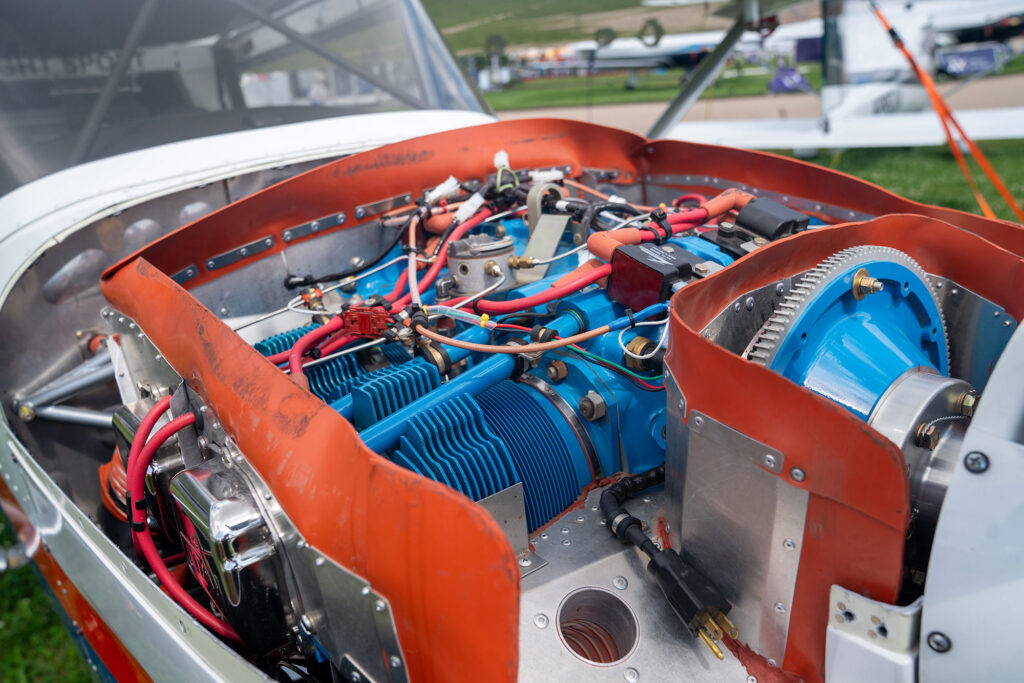
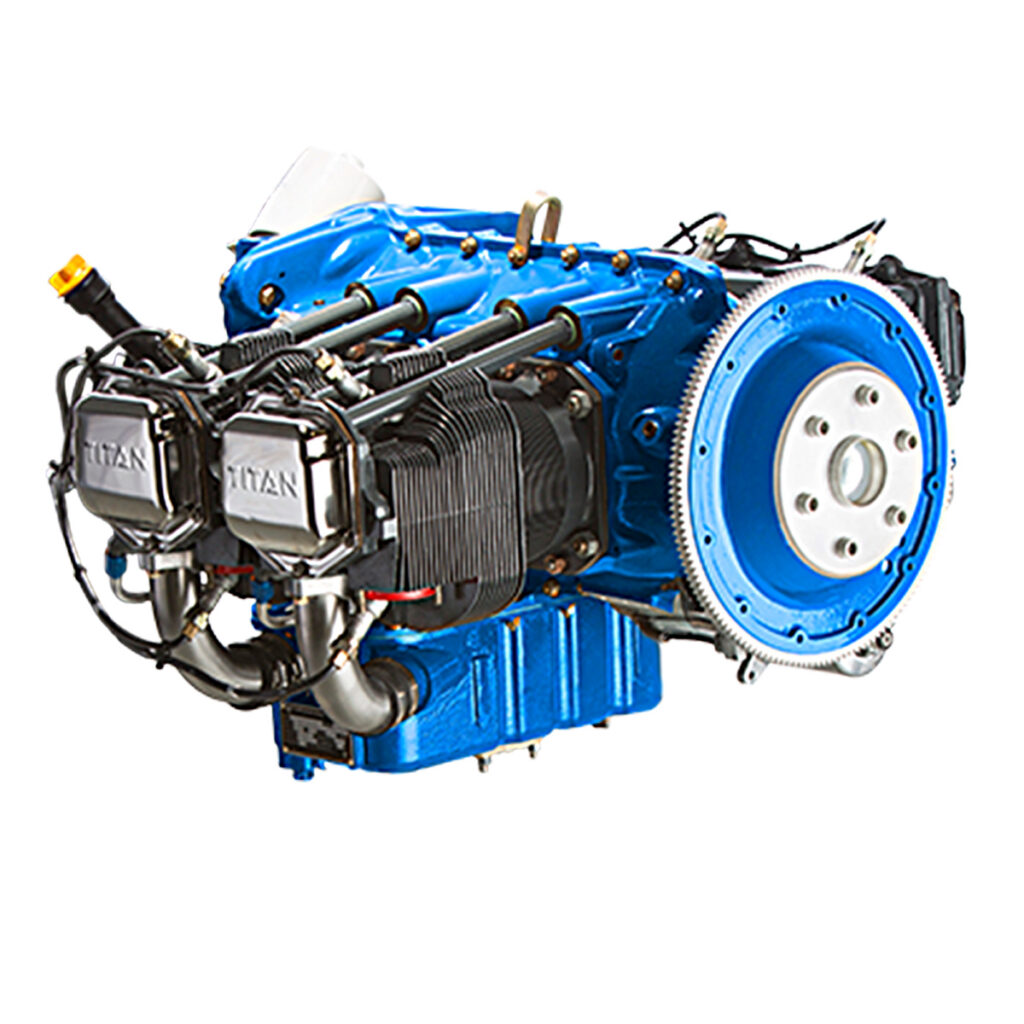
Continental is also committed to the Experimental market, with its line of Titan engines and related products. Interestingly, the Titans from Continental look a lot like Lycomings. That is because Continental’s parent company acquired a firm called Engine Components Inc. in 2015. ECI was known for producing clones of parallel-valve Lycoming engines, which, with many modifications, became Titans following the acquisition. Titan offers engines displacing 340 and 370 cubic inches and ranging from 174 hp to 195 hp.
![The Continental IOX-340 in Mike Demuth’s Rans S-21 on display at Oshkosh 2025. [Credit: Continental Aerospace Technologies]](https://www.kitplanes.com/wp-content/uploads/2026/05/Rans-S21-Titan-1024x683.jpg)
Edge Performance
This Norwegian company with distributors in North America specializes in hotrodding Rotax engines with its own turbochargers, big-bore cylinders, and other upgrades. The performance increases are impressive, with engines putting out as much as 185 hp.
Edge’s most popular engine is its EP914Ti, which begins life as an 80 hp Rotax 912 UL. Edge adds a turbocharger, new exhaust and fuel injection to bring the engine up to 125 hp. The modifications are tailored to be easy for dealers to make, and result in the Edge engine often costing less than a Rotax 914.
Jabiru
This Australian light-aircraft and engine maker continues in 2026 with its fourth-generation four-cylinder, 80 hp 2200 and six-cylinder, 120 hp 3300 engines, which are the result of a major redesign that improved reliability. The engines are known for affordability, simplicity and attractive power-to-weight characteristics.
Lycoming
The longtime industry giant for both certified and homebuilt aircraft, particularly for the Van’s RV model lineup, said wait times for new engine deliveries generally are down to less than a year compared with 18 months a year ago. The improvement reflects the company’s addition of production equipment and personnel.
The brand’s popularity stems in part from longevity and from longevity and familiarity. The engines have been part of the amateur-built aircraft segment since just after World War II and their architecture is well-known to aircraft mechanics. Just about any shop can service your Lycoming engine.
MWfly
Following enjoying success in Europe and making inroads in the U.S., Italian engine supplier MWfly in 2024 established a distributor for North America. Atilla Gahbro, based in San Pedro, California, is working to expand its dealer network.
The company sells off-the-shelf and built-to-order engines under three color-coded product lines: blue SKYline for cruising, red REDline for higher performance and the black Turbo line for flying at higher altitudes. THe engines share similar architecture with electronic tuning accounting for differences in performance.
ULPower
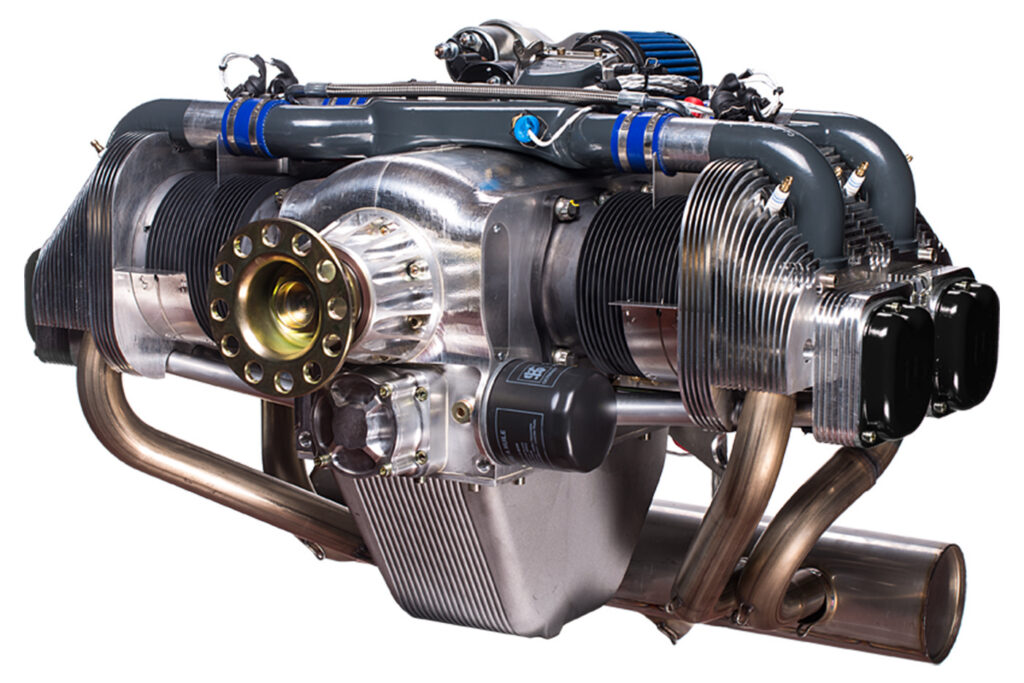
Formed by a consortium of Belgian companies, UL Power made news last year when it increased the TBO on certain naturally aspirated engines to 2,000 hours or 12 years. Its engines, which are built around air-cooled cylinders of a single design running on either a standard or long-stroke crankshaft, are in demand by builders of both lightweight and mainstream experimental aircraft.
The company is looking to establish a network of service centers in North America and also seeks technicians and FBO staffers who wish to attend its training facility in Florida.
![The turbocharged ULPower 520T produces 220 hp up to 15,000 ft. [Credit: ULPower Aero Engines]](https://www.kitplanes.com/wp-content/uploads/2026/05/ul520t-data-to-go-with-1024x682.jpg)
Inline and V Four-Stroke
Auto PSRU’s
Auto PSRU’s makes propeller speed reduction units for use with automotive engines, specifically the Chevrolet LS3, a 6.2-liter V-8 that has been used in high-performance cars like the Corvette and Camaro. The reduction units use spur gears and a centrifugal clutch. The company works with customers to put together firewall-forward setups using their reduction units.
The company has focused lately on fitting the LS3 engine to Van’s RV-10s. Customers can choose power outputs of 375 hp., 400 hp or 430 hp. The 375-hp version with the PSRU, centrifugal clutch, fuel injection, ignition, alternator and cowling costs $72,500, with delivery times for the Chevy “crate” engine at just a few weeks.
LS aeroengines
Pilots have long been attracted to the prospect of adapting American V-8 engines for use in airplanes, and the applications have improved significantly over the years. LS aeroengines of Chewelah, Washington, installs Chevrolet LS3 V-8 engines on the Murphy Moose to give the heavy hauling bush plane extra muscle. The company sells three models all equipped with factory new LS3s with power output of 430 hp, 490 hp or 525 hp, which is meant for use with floats.
All three versions are naturally aspirated and use a helical gear PSRU. THe company will help customers mount their engines on other aircraft types as well. The LS3 engines are stock from General Motors except for the addition of an LS aeroengines camshaft which, the company said, is designed to optimise durability.
Viking Aircraft Engines
Viking buys used Japanese and U.S.-made car engines and converts them to use in aircraft. The Edgewater, Florida, company produces its own gearbox and dozens of firewall-forward kits designed mostly for Zenith and RANS aircraft, but also for Kitfox, Sonex Van’s Murphy, GlaStar and others. Because prices for used auto engines are low, Viking offers some of the least-expensive power units available to amateur builders.
The company’s entry-level engine is a 90-hp version of a three-cylinder, 12-valve Mitsubishi tailored to the Zenith 701. With the Viking gearbox, the combination weighs 159 pounds. Other Viking conversions include a 1.2-liter three-cylinder turbocharged engine used in the Chevrolet Trax and Trailblazer, and Buick Encore. Honda conversions of 130 hp and 150 hp are available, as is a 140 hp General Motors engine with direct-injection, a balance shaft and the ability to use a constant-speed propeller. Viking sells the GM engine with a PSRU, exhaust manifold, computer, wiring harness and starter for $16,500.
Radial and Rotary
Classic Aero Machining
New Zealand-based Classic Aero Machining (CAM) is producing new seven- and nine-cylinder Gnome Monosoupape engines. They are faithful replicas of the Gnome rotary that was a staple for many English, French and German aircraft during World War I, including the famous Sopwith Camel. Still, the company incorporated several improvements to make the ancient design easier to operate. These include a pre-start oil priming system, fuel pump (replacing gravity feed), revised induction ports and an electric starter.
The seven-cylinder model puts out 100 hp at 1150 rpm and the nine-cylinder makes 125 hp at just 1120 rpm. KipAero, a Dallas, Texas, company that sells a line of continuation Sopwith airframes using CAM rotary engines. The companies work together closely.
Motorstar NA
Builders looking for the hard-charging power and torque that only a supercharged radial can churn out have a potential partner in Motorstar NA. The Romanian company continues to build its 360-hp version of the Vedeneyev M14, a design that dates to the 1940s but, like the Pratt & Whitney R-985 continues to have a devoted if not growing following.
While not many homebuilt aircraft can make use of the engine’s available power, a few, including the Murphy Moose and certain aerobatic sport planes welcome its prodigious brawn. While Motorstar supports the M14, it has to manufacture certain parts that have become rare–a factor that adds to the engine’s price. Still, how cool is it that you can still buy one of these? Cliff Coy at Border Air Ltd. in Swanton, Vermont, imports the engines to the U.S.
Rotec Aerosport
Some pilots find the round-engine look hard to resist, and for those building their own aircraft, the Australian company Rotec offers two small radials that are well-suited for light sport and kit-built airplanes. The seven-cylinder R2800 displaces 172 cubic inches and puts out 110 hp while the nine-cylinder R3600 is 220 cubic inches and generates 150 hp. The engines work especially well on scale replicas.
Like all radials, the Rotec uses a remote tank for scavenged oil, and Rotec will fabricate these tanks to fit customer’s aircraft as an option. Since the Rotec radials have been on the market for decades, they have been fitted to many airframes, and the company might have the tank you need.
Verner Motor
Czech engine maker Verner Motor is relatively new to the market but has gained momentum quickly with its line of radials ranging from three to nine cylinders. All of the engines use the same two-valve cylinders and run on premium mogas. The engines measure 32 inches in diameter and because of their slow-turning, direct-drive design, they are known for making extremely pleasing sounds.
All Verners use S&S Super G carburetors that will be familiar to fans of big domestic V-twin motorcycles. Customers operating at higher altitudes often choose a Marvel-Schebler carburetor from Verner to gain a traditional mixture control. The Super G compensates up to roughly Denver altitudes but not higher. Some customers have solved the problem with a custom single-point fuel injection system from suppliers including Airflow Performance and Brahn Sport Aircraft. Air-Cooled Volkswagen
AeroVee
The air-cooled Volkswagen aero conversion community delights in the light weight, low cost and legendary practicality and adaptability of the VW Type-1 engine. AeroConversions, the maker of the AeroVee engine, is the piston engine division of Sonex aircraft. A busy, pocket-size aircraft manufacturer producing everything from gliders to single-seat jet sportsters and government UAVs, Sonex’s original core is a series of airframes designed for air-cooled Volkswagen power. Now mature designs, there are no technical changes to the resulting AeroVee engines for 2025.
AeroVee engine kits include an 80-hp, 2.1-liter naturally aspirated engine and a turbocharged version rated at 100 hp. AeroVee’s laser-cut baffle system and AeroInjector slide-throttle carburetor popular options, and existing AeroVee owners can upgrade to the turbo with a $4,200 kit.
Hummel Engines
While the main mission of Hummel Engines is to supply Hummel Aircraft owners, the company also builds plenty of two- and four-cylinder VW-based engines for other aircraft. Hummel’s lineup includes basic, lightweight, low-power engines starting with a 35 hp, 85-pound two-cylinder that lacks a starter or a second magneto. The top-spec Hummel is a well-equipped, 85-hp four-cylinder with a starter, dual ignition and alternator.
Revmaster Aviation
Revmaster is the perennial VW engine shop, having built about 4,000 engines since going into business in 1959. They sell their engines assembled, not as kits, and focus on the better-equipped segment of aircraft using VW power. The company’s core product is the R-2300, a 2.3 liter, 142 cubic inch four-cylinder developing 85 hp at 3,350 rpm. Its continuous power rating is 82 hp at 2,950 rpm.
A new turbocharged version of the 2300 is now available, and develops 102 horsepower at 3,200 rpm up to 12,000 feet.
![The Continental Titan™ OX-340 and IOX-340 are 340-cubic-inch, four-cylinder, air-cooled, horizontally opposed experimental aircraft engines produced by Continental Aerospace Technologies. [Credit: Continental Aerospace Technologies]](https://www.kitplanes.com/wp-content/uploads/2026/05/OX-340-1024x1024.jpg)
Corvair
Azalea Aviation
Bill Clapp at Azalea Aviation offers Corvair engines as a sideline to his main business of producing the Saberwing aircraft. Those airplanes use the company’s 100- and 120-hp Spyder Corvair engines. The naturally aspirated 100-hp engine is built from reconditioned General Motors parts and reinforced by a steel front hub on the crankshaft, an added front main bearing, 30-amp rear-mounted alternator and other new parts. The 120-hp version has a new, counterweighted stroker crankshaft that pushed displacement to 3.1 liters while avoiding making cuts to the case to accommodate oversize, big-bore cylinders.
Fly Corvair
William Wynne, head of Fly Corvair, has developed several Corvair-based engines over more than 35 years but eventually settled on just one: the110 hp, version displacing 2,850cc. He sells the engine as a complete kit with carburetor, ignition, starter and more for $14,250, or assembled for $15,250.
In addition to keeping aviation affordable, Wynne also worked hard to keep his operations efficient and its products practical. His single-engine manufacturing strategy simplifies buying and maintaining his engines and makes it easier for owners to service and repair them. All of the pistons, for example, are manufactured to the same weight, so customers can buy cylinder repair kits without worrying about whether the new parts will disturb the engine’s balance.
Sport Performance Aviation
Dan and Rachel Weseman own Sport Performance Aviation, which produces the Panther sport airplane, which uses Corvair engines for power. While Sport Performance uses engines from FlyCorvair but also has developed its own larger-displacement versions.
The larger engines include a 120 hp 3-liter big-bore model and a 125 hp 3.3-liter model that combines big-bore and stroker characteristics. Both of these premium engines carry a significant brice bump over the engines that Wynne sells at FlyCorvair.
Jets & Turboprops
PBS Aerospace
Despite the extreme freedom one can experience building an airplane, the options suddenly narrow when you decide to build a jet, like a SubSonex, for example. The tiny personal jet was designed around the Czech PBS TJ100 turbojet, which is the only such engine available that satisfies the needs of the homebuilt aircraft segment.
SubSonex builders can order the PBS engine from Sonex, which lists the tiny turbojet on its website with hardware for $86,000.


Why didn’t you include Superior Air Parts?
A good question.
The likely reason is that the company did not respond to Kitplanes’ request for information about their products, resulting in them being omitted in the compilation of the Engine Buyer’s Guide.
I will attempt again to get in contact with the company as we prepare for future guides.
Try to Include Billet Inc. in Australia for Aluminium Housings of the Mazda Rotary engine design. Darren supplies parts only, he also supplies through a US Distributer, they are a 7 series Al. with Cast Iron wear surface inserts, he has been designing and supplying these products for 30 years in Australia for the Racing fraternity. He can supply all Engine components including Chrome Moly eccentric shafts and uses all Mazda seals. Darren keeps ahead of competition and uses FEA on any new products developments and has 6 CNC’s running to keep up with Demand.
Comments are closed.