![1936 Model 75 Boeing Stearman, s/n 003 now CF-TCQ. [Credit: Mike Davenport]](https://www.kitplanes.com/wp-content/uploads/2026/04/DSC_5743-1024x683.jpg)
A long time ago and not very far away, there was a tall, skinny teenager hanging out at Delta Airpark in Surrey British Columbia, Canada. Kevin Maher rode his bike from his home in Ladner to the nearby grass strip and spent his weekends caging rides in anything with wings. These rides were usually in some kind of warbird such as Harvards, Chipmunks and of course, a Stearman. Some of these flights even included landings and aerobatics, heaven for a not-yet pilot.
He earned his private and commercial licenses in the early 80’s, coincidently at a nearby school that had their roots in crop spraying and fire suppression with both the Stearman and converted Avengers. Once with all of the required licenses, his desire to fly for the military or the airlines was frustrated by their rulings against eyeglasses. Not letting that affect his desire to fly, he got a job crop spraying with an Air Tractor, a form of low level aerobatics that would later morph into an airshow routine that would be a little higher than the blueberries.
Years went by and the airline’s rules regarding eyeglasses changed. Today he is a senior captain and training officer flying the Boeing 777. He maintains his love for both warbirds and aerobatics. His tenacity and sense of purpose in all things led him to start and complete what became a 30 year project; the restoration of a 1936 Model 75 Boeing Stearman, serial number – 003 now registered as CF-TCQ.
Serial number 003 was built in 1936 and her career followed the usual Stearman story line. Fitted with a Lycoming R-680-5, her first task while based at Randolf Field in Texas, was to spend approximately 3,000 hours as a primary trainer for the United States Army Air Force. While doing her part as a trainer and subject to of the usual trials and tribulations associated with student pilots, ended up going over on her back at least once. This incident required the replacement of the entire tail portion of the fuselage. Due to the then availability of parts, the mechanics simply went to the parts bin and located the required assembly and welded it in place. This repair, while the welds are crude, remains today as a testament to Kevin’s commitment to restoration rather than replication.
Discharged from active duty in 1945 along with approximately 10,000 others and placed in storage, three years later in 1949, 003 was one of 18 purchased by Agair Inc. and was registered as N684192. Once fitted with a hopper and a 450 HP P&W R985 she went on to be a hardworking member of the crop spraying club and accumulate a further 5,000 hours. At the end of her working days early 1983 she was sold along with several others to an “investor” and stored once again until Kevin came along in 1995.
Spraying for 34 years and then being stored outside for another 12 didn’t do anything to make the restoration any easier. However, work wouldn’t start right way as the project spent a further 3 years in a container. Kevin says that of the 6700 hours, at least half was spent learning and the other half actually restoring. Many parts had to be made with some requiring both special tooling and skills . All of the work was all done at home except for the painting. He sprayed the primers in a rented shop spray booth but left the spraying of the distinctive red and blue colours to be done by professionals, one of the few tasks jobbed out to others.
This was not an easy project with many components needing either repair or as in the case of the four wing panels; new ones had to be built as had been replaced some time in the 60’s, most likely due to an accident but time and glue failures had taken their toll. Kevin did use some wood salvaged from the spars to form the ribs, so yes, some of the wood is original. Many components had to be either rebuilt or replaced.
The changes made, such as adding the second set of ailerons, required STCs–a total of 14. While some were easy such as the fabric and spin-on oil filter, others were not so simple. The installation of the big P&W is particularly noteworthy in spite of the fact that Boeing had done it in the 1930’s. He had the engine overhauled by AeroRecip in Winnipeg, Manitoba, a company with over 30 years of experience with large piston engines. While that was being done, Kevin had to engineer and certify the entire engine installation from scratch. Many “in the know” said it couldn’t be done and they may have been correct but for the help of the very talented DAR, Jim Watson.
Now that these are completed, the Stearman is operating with a standard C of A. It is important to note that both Transport Canada in Ottawa and Boeing in Seatle, who hold’s the Type Certificate were very helpful during the project. Boeing provided the 11,000 drawings (that is not a typo) to enable Kevin to build the necessary parts and to prove that they were done to the appropriate standard.
The devil is always in the details. One example is the time that was required to paint the Stearman logo on the fuselage sides. This took many stress filled hours and of course it had to be done twice, once for each side. Others include such as the ‘viewing ports’ in the wings to visually check spars and fittings for cracks or other failures. These were required by army mechanics for as trainers; the aircraft were frequently ground looped and this window allowed an instructor to determine if any repairs beyond fabric was necessary.
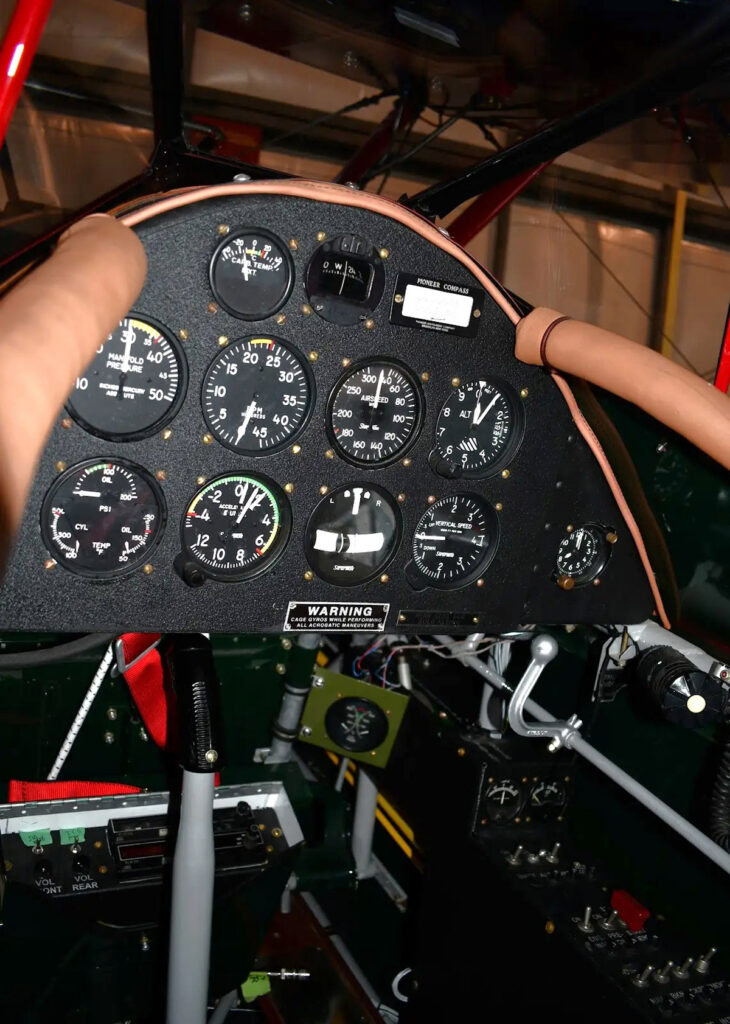
Kevin had to learn how to make smooth round aluminum parts such as the cowling, the wheel pants and others such as the fuselage fairing. The front and rear instrument panels, fabricated from new material have a distinct lack of square openings as Kevin elected to go with the more traditional ‘steam gauges’ in keeping with the vintage look. There may be a bracket for an I Pad but….
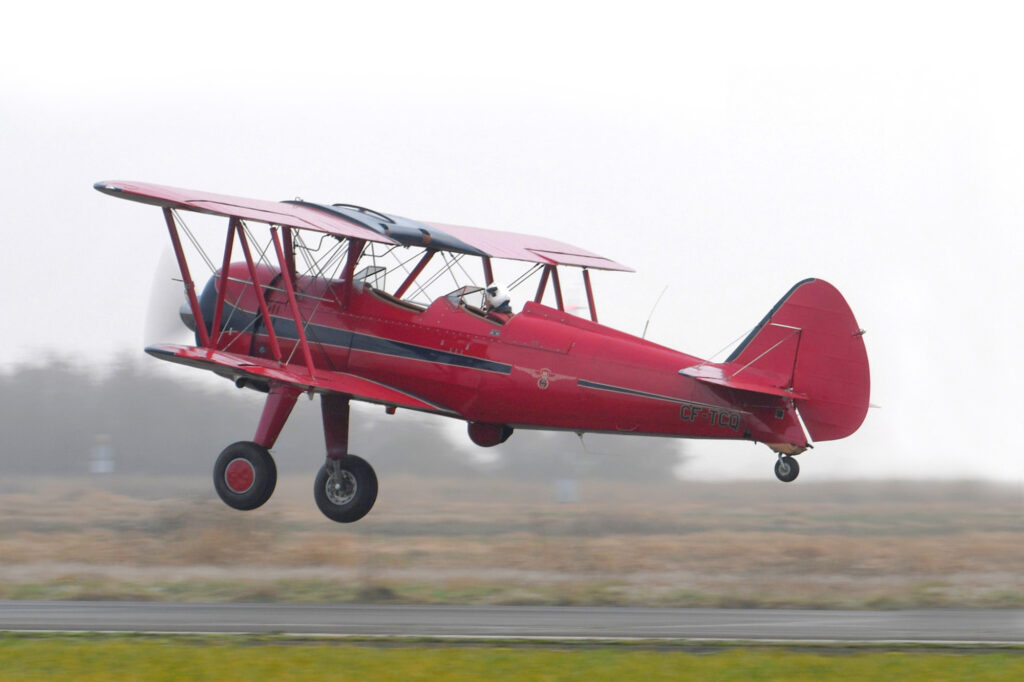
Due in part to his attention to detail and the engine cowlings, full throttle produces an airspeed of 150 mph! However, Kevin will only use that power setting for takeoff as the fuel flow is a stupendous 56 gallon per hour! For those of you who would like to use a 985 for aerobatics, know that Kevin’s experience has determined that a 10 minute show uses both 10 gallons of fuel and 10 gallons of smoke oil.
Once a rigorous flight testing program was completed and with 12 hours on the ‘new’ Stearman, he flew her from Victoria on Vancouver Island to the Boundary Bay airport where he invited friends to a well attended unveiling. Later that same day, after a delay caused by some local fog, he flew her to a new home in the Okanagan Valley. He did have one complaint. He found it a little chilly at 10,000 feet in January.
This summer he will be displaying and demonstrating the Stearman’s capabilities at airshows and flyins in both BC and Alberta. He wants the aircraft to be seen and touched and has no concerns about a few rock chips and fingerprints