![The integrated ECLIPSE NG features a very sunlight readable display that shows the engine and all flight data organized in one or more pages. [Credit: Fielden Aero LLC]](https://www.kitplanes.com/wp-content/uploads/2026/04/1_Screenshot_-1024x704.jpg)
Avionics decisions in the experimental world have a way of becoming permanent. Not because builders can’t change them later, but because “later” usually arrives right about the time you’d rather be flying than repinning connectors. Flybox Avionics (Microel s.r.l., Italy) has been gaining ground in U.S. homebuilt panels because the product line checks several boxes that don’t always coexist: modern capability in compact formats, high screen readability, a shared computing foundation across instruments, and a practical firmware update pipeline. Add one standout control product—the APR1 Automatic Propeller Controller—and you have an ecosystem that can scale from simple VFR to highly capable cross-country panels without requiring a full panel reinvention.
This article focuses on what the avionics actually do, where they fit, and why these products have become a serious option for a wide range of homebuilders.
Flight and Engine Instruments: Useful Capability in Compact Formats
Flybox’s product line is organized around a simple premise: deliver meaningful cockpit information without demanding a panel the size of a dining room table. That shows up most clearly in the company’s round-format instruments, where EFIS-style presentation is packaged to fit standard cutouts.
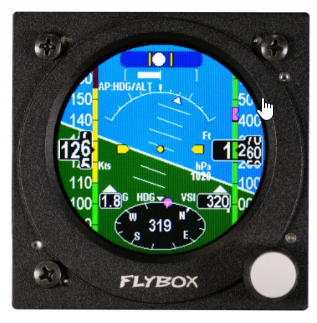
A representative product is the OBLÒ flight instrument. The key advantage of a round-format “glass” instrument is not aesthetic—it’s packaging and placement flexibility. A 3-1/8-inch hole is a known quantity in homebuilt panels. That makes it easier to design around, easier to retrofit, and easier to build redundancy by distributing capability across more than one display. Round-format glass also tends to preserve an intuitive scan: attitude and key flight information where the eye expects to find it, presented with modern symbology and presentation.
On the engine side, Flybox offers both rectangular and round-format monitoring options. Two commonly discussed products are EngiMaster (a compact rectangular-screen engine monitor) and My-EMS (a round-format engine monitor). These cover the same operational need—clear presentation of engine parameters with meaningful alerting—through different packaging strategies. Some panels want a dedicated rectangular display for dense engine data; others prefer a round instrument that fits where a traditional gauge would live.
For engine monitoring, the differentiators that matter in use are straightforward. First is clarity: the ability to see the parameters that drive decisions—temperature and pressure trends—without the display becoming a small-font contest. Second is trend awareness: the early warning signs of engine changes are usually subtle and incremental. Third is alerting that’s both visible and meaningful, so the system highlights deviations that deserve attention without teaching you to ignore it.
Flybox’s strength here is that the product family offers multiple form factors while keeping the instrumentation goals the same: readable, functional displays that support quick interpretation.
![The APR1 Propeller Controller optimizes speed and fuel consumption. [Credit: Fielden Aero LLC]](https://www.kitplanes.com/wp-content/uploads/2026/04/APR1.png)
APR1 Automatic Propeller Controller: A Feature that Changes Workload
Most avionics products compete by presenting more data or presenting the same data in a different way. APR1 is different because it changes how the airplane is operated.
The APR1 Automatic Propeller Controller is popular in the homebuilt market because it can convert an airplane with a variable pitch propeller into single-lever engine control. Instead of the pilot managing throttle and propeller control as separate tasks, APR1 manages propeller behavior automatically to meet the selected operating targets.
The important detail is configurability. APR1 configuration is customized to the desired flight parameters of the builder/pilot. That means the system can be tuned around priorities that vary by aircraft and mission: climb behavior, cruise efficiency, consistent operation across multiple pilots, or simply reducing pilot workload in phases of flight where there is already plenty going on.
APR1’s practical value proposition can be summarized in three points. It reduces task loading by removing one control loop from the pilot’s hands. It improves consistency by driving repeatable outcomes for a given power demand. And it enables customization, so the system behavior reflects the aircraft’s mission profile rather than forcing a one-size-fits-all control philosophy.
Any system that influences engine/prop behavior deserves disciplined installation, careful configuration, and conservative test practices. But from a capability standpoint, APR1 stands out because it is not a cosmetic feature—it is an operational change.
A Shared Architecture, Predictable Updates, and Support that Resolves Issues
Flybox instruments share a common computing architecture across the product family. That matters for three reasons. First, it tends to produce consistent configuration logic and interface conventions across multiple instruments, which reduces friction when products are installed together. Second, it supports cost efficiency. Reusing core processing hardware and software frameworks across a family can reduce duplicated development and component complexity, which can translate into a more budget-friendly retail position. Third, it supports a faster improvement cycle. A shared platform makes it easier to deploy fixes and enhancements across multiple products as updates are posted.
![The Omnia Fuel monitoring system can display up to 4 fuel tank levels that can be enabled individually to suit your needs. [Credit: Fielden Aero LLC]](https://www.kitplanes.com/wp-content/uploads/2026/04/Oblo-2.png)
![The OBLO round EFIS consolidates all attitude intrument information in one compact display. [Credit: Fielden Aero LLC]](https://www.kitplanes.com/wp-content/uploads/2026/04/Omnia-Fuel-L-P.png)
Firmware updates are part of modern avionics life; the differentiator is whether owners can keep current without turning updates into a project. Firmware updates are available through the Fielden Aero website, and customersd receive email notifications when updates are posted. That creates a predictable process for maintaining current versions and reduces “version drift” across the installed base.
Flybox instruments are now installed in a wide variety of homebuilt aircraft, and that breadth contributes to a deeper base of installation experience. In the U.S., Flybox products are supported through Fielden Aero, LLC. Fielden Aero is honored to have been selected as the exclusive U.S. dealer and provides full-spectrum support—sales and service including installation guidance and technical support. In troubleshooting, the approach that consistently resolves installation issues is evidence-driven: review the builder’s wiring diagram for potential issues and validate against photos and videos of the installation. That method has proven effective in resolving installation problems quickly and completely.
![A sleek Glasair II. [Credit: Glasair]](https://www.kitplanes.com/wp-content/uploads/2026/08/Glasair-II_2863.jpg?w=218&h=150&crop=1 "Class of ’86: How 1986 Transformed the Modern Kit Building Industry")
![Careful planning and determination will get you to your goal of building and flying your own airplane. [Credit: AdobeStock]](https://www.kitplanes.com/wp-content/uploads/2026/05/Pulsar-Sunset.jpg?w=218&h=150&crop=1 "Last Bits")
![Making rare use of my drafting tools for the internal timing. [All Images Credited to Andrew Robinson]](https://www.kitplanes.com/wp-content/uploads/2026/05/P1010535.jpg?w=218&h=150&crop=1 "Conquering the Magneto, Part 2")
![[Credit: AdobeStock]](https://www.kitplanes.com/wp-content/uploads/2026/05/AdobeStock_262642207_AGCuesta.jpg?w=218&h=150&crop=1 "Winging It")
![Lowell Farrand spent years serving as an FAA DAR and is in the EAA Hall of Fame. He offers sound advise to builders. [Credit: Bill Wilson]](https://www.kitplanes.com/wp-content/uploads/2026/05/unnamed-4.jpg?w=218&h=150&crop=1 "Think Like a Builder")
![Humberd and his daughter using the 701 for some farm duty transportation. [All Images Credited to Jon Humberd]](https://www.kitplanes.com/wp-content/uploads/2026/05/1-3.jpg?w=218&h=150&crop=1 "Builder’s Spotlight")
![Andrew bought a Thorp T-18 project, which started him down the road to experimental aircraft project ownership and construction. [Credit: Andrew Robinson]](https://www.kitplanes.com/wp-content/uploads/2026/04/IMG_7725-scaled.jpeg?w=218&h=150&crop=1 "Winging It")
![[Credit: Chat GPT]](https://www.kitplanes.com/wp-content/uploads/2026/04/Generated-image.jpg?w=218&h=150&crop=1 "Homebuilder’s Insurance")
![Checking out East Tennessee scenery from the 701. [Credit: Jon Humberd]](https://www.kitplanes.com/wp-content/uploads/2026/04/3.jpg?w=218&h=150&crop=1 "Builder’s Spotlight")