
![[Courtesy: Aeromarine]](https://www.kitplanes.com/wp-content/uploads/2025/11/WhatsApp-Image-2025-05-28-at-14.31.27_7fbfa7b5-1024x683.jpg)
There’s something almost ironic about how the most affordable sport aircraft on today’s market traces its lineage to the Czech Republic, a country that wasn’t even on most pilots’ radar screens twenty years ago. Yet the Aeromarine Merlin Light Sport Aircraft represents perhaps one of the best answers to the age-old aviation question: “How do I get in the air without breaking the bank?”
The Merlin’s story begins in the workshops of Czech Aircraft Works, where the original design took shape, in the former Soviet era Let a.s. factory in Kunovice, Cech Republic. When Chip Erwin, a serial aviation entrepreneur with four decades of experience bringing affordable aircraft to market, encountered this Czech-designed single-seater, he recognized something special. After building over 750 aircraft through his previous company, Czech Aircraft Works, and creating three LSA models including the SportCruiser (which became the PiperSport), Erwin knew what worked and what didn’t in the kit aircraft business.
The relationship between Aeromarine LSA and the Czech design house exemplifies modern aviation’s global nature. While the Merlin’s DNA is unmistakably European—with its precision engineering and efficient use of materials—its transformation into an American success story happened at M-Squared facility located at St. Elmo Airport near Mobile, Alabama where Paul Mather manages the build center for all of Aeromarine’s line of aircraft. The Merlin represents a genuine collaboration that brings European design sensibilities to American building techniques and regulatory requirements.
What makes the Merlin particularly compelling is how it addresses the fundamental economics of sport aviation. At a time when even basic LSAs are pushing toward six-figure price tags, the Merlin delivers genuine 130-mph true airspeed performance in a package that starts at $48,500 fully built and ready to fly. That’s not a typo. And the base price includes a modern 60 hp Vtwin engine that features electronic fuel injection and electronic ignition, basic instrumentation, and most importantly, Aeromarine’s two-week builder assist program that takes you from kit to first flight. For $57,000 the aircraft is fitted with an EFIS with synthetic vision, a moving map, engine monitoring system, and ADSB out.
The build time story is where the Merlin really separates itself from traditional homebuilt projects. This isn’t about spending evenings and weekends in the garage for three to seven years. Erwin’s company has earned FAA approval for their Quick Build Kit by the slimmest possible margin—just 0.01% over the minimum 51% builder contribution requirement. That means maximum factory completion while still qualifying for Experimental Amateur-Built certification.
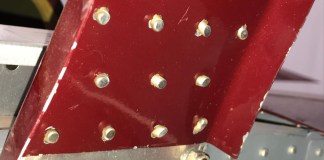
The secret lies in what Aeromarine calls “precision matched-hole technology.” Instead of the traditional approach where builders receive pilot holes that must be drilled to final size, every hole in the Merlin kit comes punched to exact rivet diameter. Multiply that time savings across thousands of rivet holes, and you’re looking at hundreds of hours saved. Major assemblies like the horizontal stabilizer and elevator arrive significantly pre-assembled, with temporary colored rivets holding components in place during shipping. The builder simply removes these temporary fasteners and installs permanent rivets in their place.
The numbers tell the story of just how builder-friendly this approach is. With precision matched holes, the first week at Aeromarine’s build center completes the entire airframe. The second week handles engine installation, avionics, and final systems. Builders who prefer working at home can complete their Merlin in as little as four days with the right preparation, though most find the two-week timeline realistic for their first amateur-built aircraft.
From a performance standpoint, the Merlin delivers on its promises. The standard Aeromarine Vtwin installation provides a cruise speed of 110 to 130 mph while burning just 2.5 gallons per hour. Aeromarine test pilots have flown to 15,000 feet MSL and were still climbing. With an empty weight of 415 pounds and gross weight of 715 pounds, the power-to-weight ratio exceeds most LSAs by a significant margin. Takeoff performance is particularly impressive—Erwin claims three-second ground rolls under the right conditions, with climb rates reaching 1,400 feet per minute.
The single-seat cockpit provides more space than many pilots expect. At 27.5 inches wide, there’s adequate room for larger pilots, plus a surprisingly generous baggage area that can handle 25 to 40 pounds depending on configuration. The cabin features vertically hinged doors and conventional stick-and-rudder controls that feel familiar to anyone with LSA experience.
An autopilot option provides single-pilot IFR capability for longer cross-country flights.
The Merlin’s market positioning becomes clearer when compared to alternatives. A basic new LSA from established manufacturers typically starts around $150,000 and quickly escalates toward $200,000 with useful options. Even well-regarded used LSAs command prices in the $80,000 to $120,000 range. The Merlin, fully optioned with glass panel, autopilot, a Galaxy Rescue System (GRS) parachute, and paint, reaches the market at roughly $62,000.

Sorting The FAA Legalities
As an Experimental Amateur-Built aircraft, the Merlin avoids the certification costs and regulatory overhead that drive LSA prices skyward. Maintenance can be performed by the owner with appropriate supervision, annual condition inspections cost a fraction of LSA requirements, and modifications remain possible throughout the aircraft’s life. Yet the Merlin meets all LSA parameters, making it legal for Sport Pilot certificate holders to fly and has been certified in the EU to the UL-2 standards.
For pilots considering the Merlin, the single-seat limitation represents both the aircraft’s primary compromise and its essential strength. This isn’t about family flying or commercial training operations. It’s about pure personal aviation—the kind of flying that brought most of us to aviation in the first place. Dawn patrols, evening pattern work, cross-country adventures where the destination matters less than the journey itself.
Chip Erwin’s background brings credibility to the Merlin program that extends beyond typical kit aircraft ventures. His previous success with Czech Aircraft Works, including LSA certification of multiple designs and establishment of manufacturing facilities in China, demonstrates both technical competence and business sustainability. His seaplane racing achievements and test pilot experience provide the practical flying background that informs design decisions.
The Merlin represents something significant in sport aviation’s evolution: proof that affordable flying remains possible without compromising safety, performance, or build quality. In an era when aviation seems increasingly accessible only to the wealthy, the Merlin offers a different path forward. It acknowledges that many pilots would gladly trade a second seat for genuine affordability, especially if that affordability comes with 120-mph cruise speeds and two-week build times.
Whether this represents the future of sport aviation remains to be seen. But for pilots seeking a path to flying without an enormous financial outlay, pilots looking for their first aircraft purchase, the Aeromarine Merlin deserves serious consideration. It may well represent the best value proposition in aviation today.


This is exactly what general aviation has needed – a design that recognizes that most people do not have a budget of six figures to buy a recreational airplane. At a time when more people are living paycheck to paycheck, LSAs with price tags of $150,000 and up are simply non-starters. Like the popular Sunfish small sailboat that helped create the sailing hobby in the US, the Aeromarine Merlin will provide an entry into sport aviation for the average person, not the already wealthy…..Bravo!
Correct, this and the Spirit SE-1.
The only thing that prevents me from jumping in is it doesn’t have a folding wing. Hangars in my area are mostly unavailable, and when they are they cost more than a payment on this airplane.
a flolding wing would be much appreciated. Also how does one address the biannual flight review regs?
The owner -builder will be issued a repairman’s certificate to to all the maintenance for that specific n numbered plane.
After a costly ‘attempt’ to buy a Merlin I ended up buying a Spirit Engineering SE-1. A little more expensive but already built and actually available. Worth waiting for.
Comments are closed.