
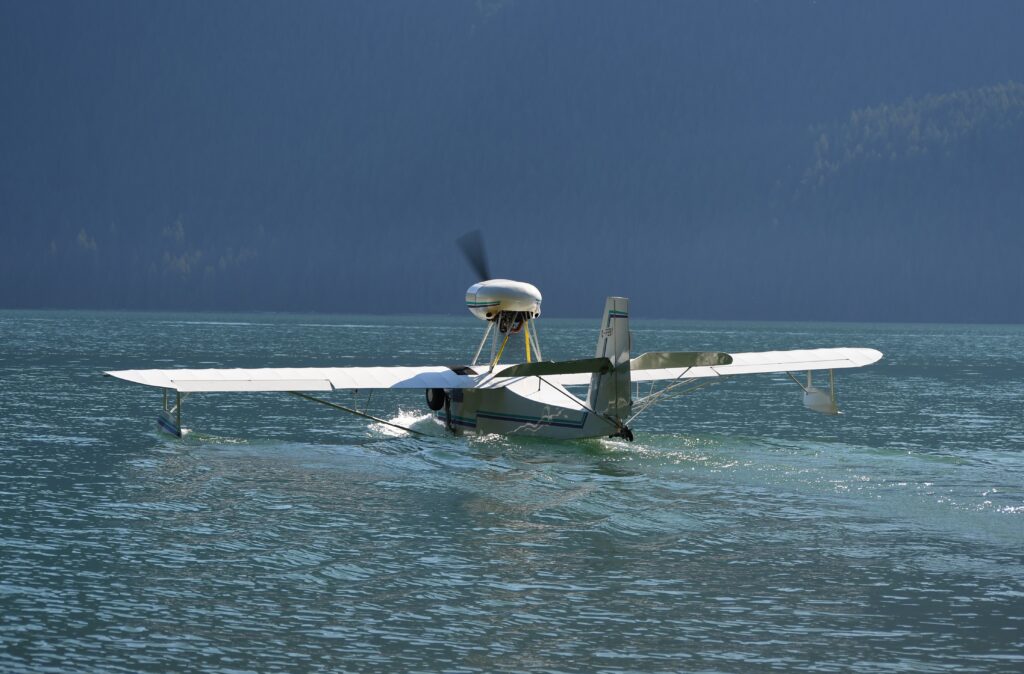
Where are they now? While that question has been asked many times, this time it relates to amateur-built aircraft. A look through my bookcase led me to the 1973 Air Progress annual that claimed to list all of the plans built aircraft of the day. This 190-page epic sold for just $2.95, so that will tell you – yes, things have changed. Aircraft kits were virtually non-existent. Instead, builders would spend fifty to one hundred dollars for a set of plans and then source all of the material, mostly wood to construct their dream aircraft, for in some cases just $5000. Air Progress listed 143 different sets of plans that ranged in price from $50 to $125.
Just like today, many were started but fewer were actually built and flown. This story is about three of those that were completed and are still flying today. All are flown regularly, if not daily. One of the three is flown by the original builder. Another by the builder’s son. Three plans built planes that have survived to this day are a Steen Skybolt, a Volmer Sportsman and a Piel Super Emeraude.
All three aircraft reside at the Langley, BC airport. Located in the lower mainland of British Columbia, this small regional airport has 3 flight schools, numerous aviation related businesses and a large general aviation population. The majority of GA are located on the west side of the airport and are housed in a large number of both new and older hangars. While prowling around the hangars for more years than I care to remember, I located a large population of amateur built planes. These include a significant number of completed and flying kits, three others stand out as special. What follows is the story of those three.
In no particular order this review is of these three very special homebuilts.
Steen Skybolt
Lamar Steen designed the aerobatic Skybolt in 1968 to meet the needs of larger pilots. The plane could be called an early “composite” as the construction included a welded tube fuselage, wooden wings covered with fabric requiring a multitude of skills. The prototype was built by the designer’s high school shop class in just one year. It was powered by 180 hp Lycoming but as more and more were built, the power has crept up to 260 horsepower and beyond.
John Watt, an RCAF and later a TCA/Air Canada pilot liked the Skybolt so much that he built two of them. One, C-GDJM was an Oshkosh prize winner in it’s first outing and what follows is the story of that Skybolt today.
Currently owed and meticulously maintained by Peter Dryer, who among other skills has also been an airline pilot and has enjoyed aerobatics in both the Pitts Specials and the Extra. Since purchasing the Skybolt from an estate in the Okanagan.
Dreyer has installed a larger engine and a 3 blade propellor as well as replacing most of the “steam gauges” with their updated digital counterparts.
Designer’s Spec’s
- Power – 180 to 250 hp
- Span – 24 ft
- Length – 19 ft
- Height – – 7 ft
- Wing Area – 155 sq ft
- Gross – 1650 lbs
- EW – 1080 lbs
- Fuel – 29 gals
- Baggage – 40 lbs
- Manhours to build – 2,000 plus
- Plans cost – $50
Volmer VJ22 Sportsman
This wooden amphibian, designed by Volmer Jensen in the late 60’s and built by Bill Eby over a period of five years. First flown in 1970, 55 years ago and he flies it to this day. The Sportsman was built in Kitchener; Ontario beginning in 1965 and finished 5 years later in 1970. The black and white photos show the complex nature of a plans built wooden aircraft. Every part had to be painstakingly handmade from the designer’s drawings.
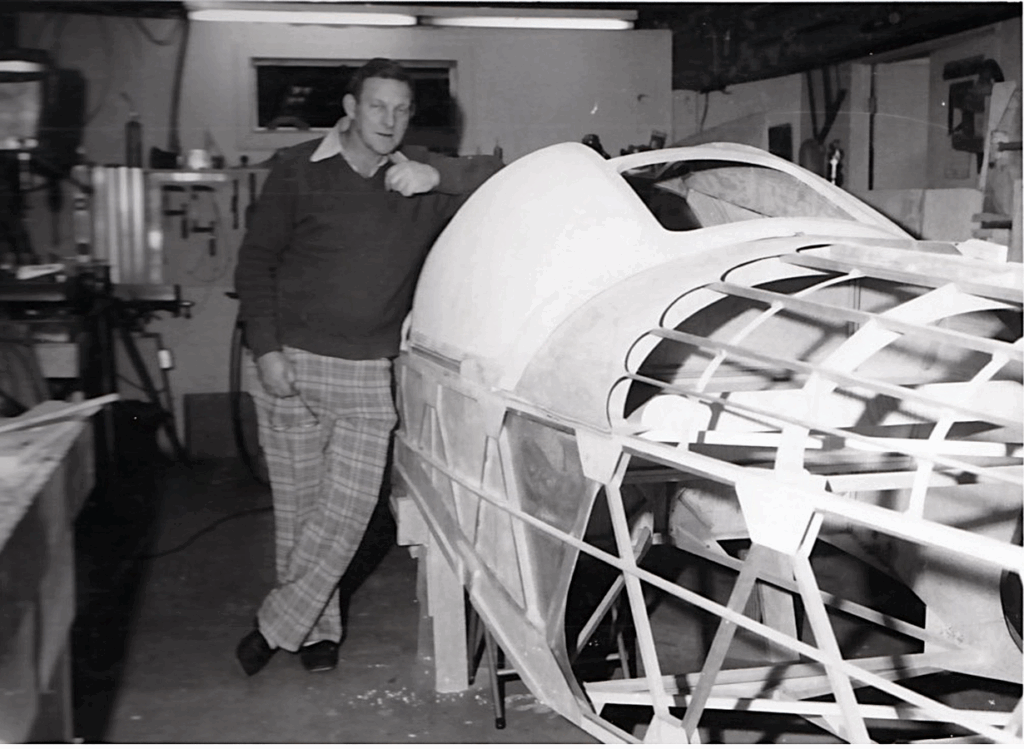
Eby who now makes his home in the skier’s mecca of Whistler, BC is able to land on Green Lake and taxi to his private dock.
Powered by a tractor mounted 125 hp converted GPU (Ground power unit, purchased for $250.00) As recommended by the designer, Champ wings located, purchased, repaired, and covered before being installed.
Among the modifications, the most noticeable is the change from a pusher to a tractor mounted engine requiring that Eby design a totally new mount. Less noticeable is the gear retraction method. The original design called for a large lever located between the seats that had to be raised and latched to a fitting near the roof. He designed a crank and chain mechanism that while it requires 35 turns to raise or lower the wheels, is much easier to operate than the afore mentioned lever.
Cost to build in 1970 dollars: $5,000.
Eby updated his amphib in many ways after a time in storage as he was preoccupied with building a 40 foot catamaran. Included in the updates was the installation of some “glass” and an autopilot capable of following a preset course and all important 180 degree turn.
Designer’s Spec’s
- Engine – 80 to100 hp
- 125 hp
- Span – 36 ft 6 in
- Length – 24 ft
- Height -8 ft
- Wing Area – 185 sq ft
- Gross – 1500 lbs
- EW – 1000 lbs
- Fuel – 20 gal
- Baggage – 64 lbs
- Manhours to build- Est – 2000 hrs
- Plans cost – $125
Piel SUPER Emeraude:
A cabinet maker who was renowned for his woodworking skills, the late Colin Walker hand crafted this all wood beauty over a period of ten years, completing it in 1980 at a cost of $10,000.00. (this converted to 2025 dollars would be north of $36,000)
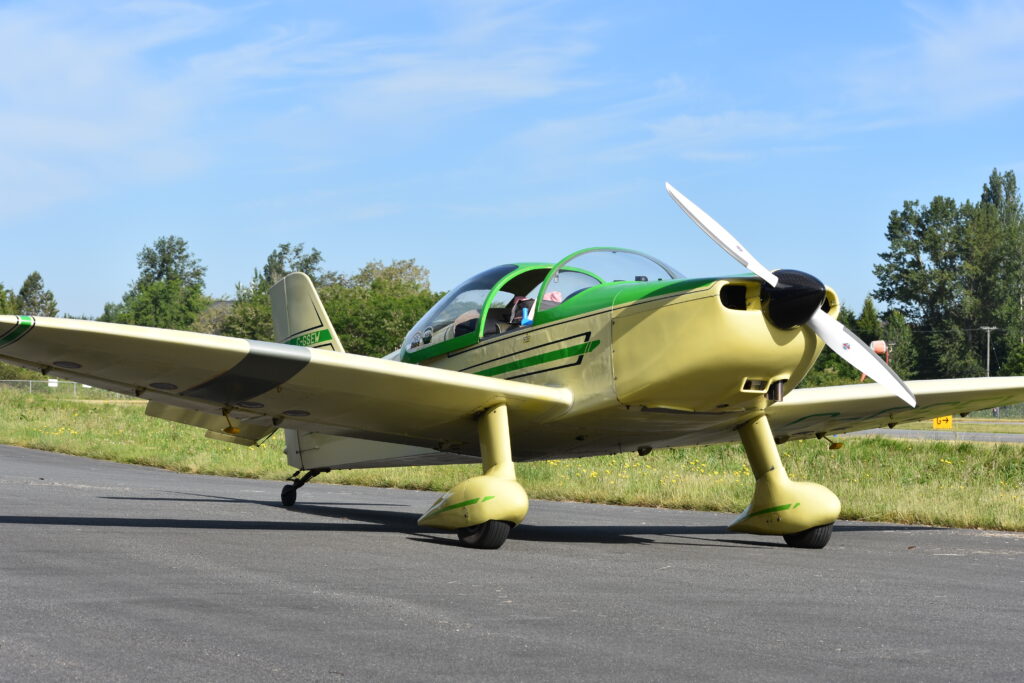
I had the opportunity to visit his basement shop in suburban Vancouver and admire the complex elliptical wing then under construction. I recall some lighthearted discussion about finding a transparent covering as it would be a shame to hide his exemplary woodwork. However the final covering and finish is more conventional and remains unchanged to this day.
Today the Emeraude is owned and flown regularly by his son Sean who has known the plane since birth. In addition to the usual local flights to flyins and airshows, he has flown numerous trips to Ontario, a round trip distance of 8600 kilometres; that’s 5300 miles for the metrically challenged.
Sean, while adding some 600 Emeraude hours to his logbook is carrying on with his father’s reputation for skill and tenacity as he nears completion of an exceptional Glasair Sportsman 2+2.
Designer’s Spec’s
- Power – 100 – 150 hp
- Span – 26 ft
- Length – 21 ft
- Height – 8 ft, 4 in.
- Wing Area 117 sq ft
- GW – 1500 lbs
- EW – 850 lbs,
- Fuel – 25 Gallons
- Baggage – 132 lbs
- Manhours to build – Est. – 2200 hours
- Plans cost – $50
A comprehensive article discussing kit planes and their history from design to the present day would be very interesting. I have a collection of old aviation magazines, including many from Kitplanes, and rereading them is fascinating. One noteworthy conclusion is that the majority of owner-built designs aren’t around anymore, and you have to wonder why. Each of these designs probably has an interesting story to tell, and there’s probably more than a few cautionary tales. It also appears that the comparative lifespan of the various designs varies a great deal – some seem to soldier on, while others are abandoned. This seems odd when keeping in mind the long lifespans of certified aircraft.
I’m building a super emeraude, I only have fairings, baffles and some miscellaneous to complete. Aside from the O-320, much of the cost is in the instrumentation and oratex covering. Oh, and 12 years of weekend work as I travel for work.
Comments are closed.