
![Builder and pilot Mark Farver stands alongside his Continental IOX-340 powered RANS S-21. [Credit: Mark Farver]](https://www.kitplanes.com/wp-content/uploads/2026/09/Copy-of-build-38-Topaz-Gigapixel-2x-scale.jpg?resize=1024,682)
The call came a half mile out from FISK.
“High wing, half mile from Fisk, rock your wings.”
Mark Farver rocked them.
“Good rock. Welcome to Oshkosh.”
He had been waiting ten years to hear it, and two and a half of those years he had spent building the airplane that finally carried him there. N319PG — Papa Golf — is a RANS S-21 Outbound, all-metal, taildragger, on tundra tires, silver over navy with safety-orange trim. Farver built it himself at Little River, California, wired every circuit in it, painted it, and flew its first flight. On Saturday, July 18, he put it on the yellow dot at Wittman Regional after 48 days and 49 legs across the country, with his wife Carin Berolzheimer in the right seat calling traffic.
“We finally arrived at the Mecca of aviation in our own plane that we built,” he wrote that night from a tent under the wing.
It Started in a Tent
In 2022 Farver walked into a workshop tent at AirVenture and sat down for a class called “You Too Can Build A Plane.” The pitch, as he remembers it, was blunt: if you can build a BBQ, you can build an airplane.
He had the background for it. Farver is a third-generation flyer — his grandfather flew without a license, which is its own kind of family credential. His mother, Marge Farver, now 88, grew up flying with her father in a J-3 Cub off the family hay field in Huron County, Michigan. Farver soloed in 2008 at the East Hill Flying Club in Ithaca, New York.
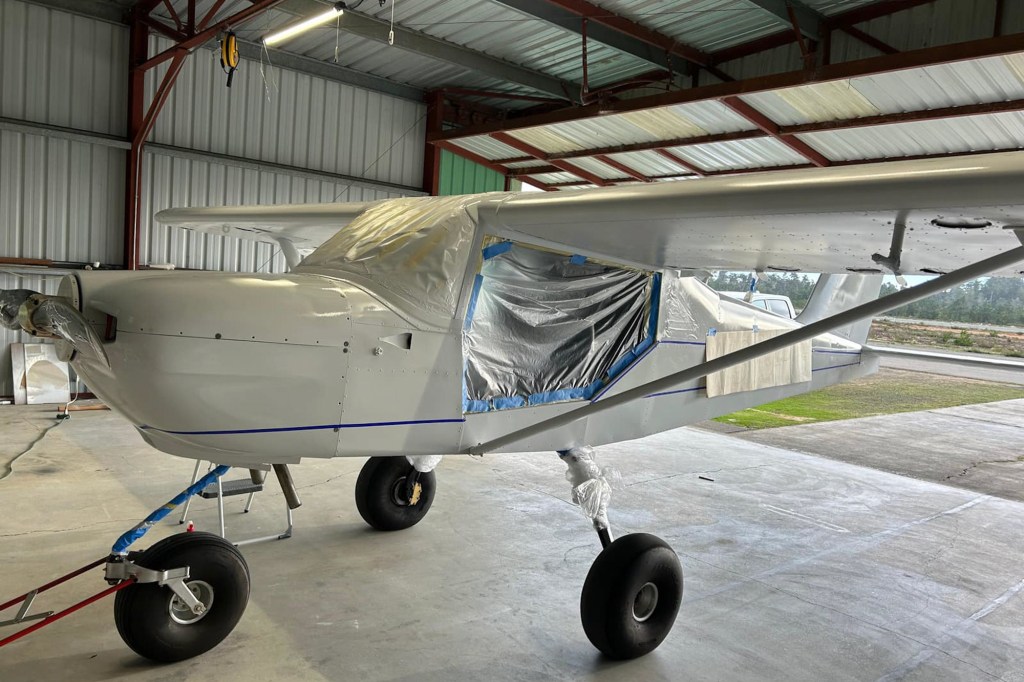
What he had not done was build. He picked the S-21 Outbound, the all-metal two-seater Randy Schlitter’s RANS Designs introduced at AirVenture in 2016. It is a chromoly cage with aluminum skins aft, match-hole drilled throughout, no welding required, and RANS quotes 700 to 1,000 hours to build. Farver ordered the big engine: the Continental Titan IOX-340, 180 hp, fuel injected, electronic ignition, swinging an 80-inch Whirl Wind propeller. With the Titan the airplane runs about 985 pounds empty against an 1,800-pound max gross weight, leaving better than 800 pounds of useful load — the number that makes a two-month cross-country realistic.
Two and a half years later he had an airplane. He did the electrical work himself and the paint himself, and when it came time to fly it, he did that himself too.
“One year ago today was the first flight of N319PG,” he wrote on the second night of the trip. “The pucker factor was high that day and I did my best impersonation of Chuck Yeager the test pilot.”
Carin’s account of why she signed on is as honest as most trip narratives get. She took a “Right Seat Ready” class to learn enough to land the airplane in an emergency. “I can tell you that if that happens, it won’t be pretty, but I think I can get us down safely on or near a runway.”
Out of Little River
They left Little River on June 1 with two months blocked out, a plan to cruise VFR between 7,500 and 11,500 feet, and oxygen aboard for the high ground. The first leg went to Red Bluff for fuel, where the self-serve pump was out of order and the truck driver was at lunch. That pushed the second leg into the afternoon chop and set the tone: the airplane worked, and the schedule was a suggestion.
Day two produced the first mechanical. Climbing out of Nampa, Idaho, the cabin heater valve hung open and would not latch shut.
“Not dangerous, but not something I wanted to nurse over high terrain,” Farver wrote. “We diverted into Gooding, I pulled the panel, and it was a simple fix once I had it in my hands.”
The Gooding FBO topped off their oxygen bottle and handed over a loaner car unasked. An hour lost. Farver’s verdict: “That hour ‘lost’ is exactly the kind of thing this trip is made of.”
The next morning they launched at 7 a.m. into the calmest air they had seen, crossed the black lava flows of the Snake River plain at sunrise — Carin described it as flying over a frozen, broken sea — and topped off at Bear Lake County, Idaho. Then they pointed the nose at the mountains.
Around the Rockies
They did not go over the Rockies so much as through them.
“We got around the Rockies by finding the lowest spots on the map — which, it turns out, are also where the roads and the rivers go,” Carin wrote from Casper that evening. “We followed the gaps through the Wyoming Range, granite country bare and scoured below us, and came out on the east side. We were on oxygen for over two hours, cruising between 9,500 and 11,500 feet, watching the snow still tucked into the high north faces.”
Then the line that says more about how this trip was flown than any altitude figure: “I won’t pretend I wasn’t nervous about this part. But we made an ‘us’ plan, we flew it together, and now we’re sitting in Casper, WY with the hardest terrain of the whole trip behind us.”
Casper to Buffalo to a strip in the Rawhide Buttes near Lusk, then down to Longmont, Colorado, in enough chop that Farver kept a hand on the stick with the autopilot engaged. On the Longmont layover the forecast called for hail, and a local pilot who had seen Papa Golf tied down on the ramp called and offered hangar space — Tom Book of the local EAA chapter, an RV builder. The hail quit the moment they got the airplane inside.
That is the pattern that repeats for 3,000 miles. The airplane opens doors.
Across The Plains
After ten days in Colorado they pointed the nose east: Longmont under the Denver Class B shelf at 6,500 for the first 20 miles, out through a busy practice area, then quiet air to McCook, Nebraska. Kansas City was the opposite — bumpy, crowded, and the end of a long day.
“Five hours on auto pilot and not much food equals my worst landing of the trip,” Farver wrote. “Cross wind at 12 knots and crab down final and kicked out to a slip, tested my x-wind skills, let’s say, not a greaser but a safe landing.”
It is a small thing, but it is the kind of thing builders write and magazines usually edit out. The airplane was never the problem. The pilot got tired.
Burlington, Iowa, then Knox, Indiana, then across to Michigan’s Thumb. Approaching Bad Axe, Farver looked at Saginaw Bay — 18 miles across at the narrowest — and went around the south end instead. “My better judgment gets in the way of this water crossing.”
A Promise at 102
Michigan was the reason the route bent north.
Cliff Farver of Caseville is 102 and the last surviving member of a family of eleven children. He has lived in Huron County for a century. Years ago his great-nephew told him that when the airplane was finished, he would take him flying.
On June 20 they got him in. “After a little bending and passenger yoga,” Farver wrote under the photo. Cliff flew as co-pilot over the farmland and shoreline he had known since 1924, and asked to go over his house at the beach. Marge Farver, 88, flew the same day — the woman who learned to fly out of a hay field in a Cub, now riding in an airplane her son built.
“A three year promise from me is finally complete,” Farver wrote.
![Builder pilot Mark Farver with his uncle Cliff, age 102, in the right seat. [Credit: Mark Farver]](https://www.kitplanes.com/wp-content/uploads/2026/09/Copy-of-Farver_1.jpg?resize=1024,682)
A week later, at the grass strip at Sebewaing, they taxied off the runway into his brother-in-law’s back yard and parked under a sugar maple. The brother-in-law is an automotive master mechanic with a tool collection deep enough to include a one-inch socket, a torque wrench and safety wire. They changed the oil — the fourth change, 124 hours on the Hobbs — and replaced a heater duct that was running too close to the exhaust manifold.
How the Airplane Did
Worth noting, because it is the part builders actually want: nothing broke. Across 49 legs the only squawk was the heater valve on day two.
The numbers held up as well. RANS books the Titan-powered S-21 at 130 mph practical cruise and 8.0 gph; Farver logged 130 mph and 7.8 gph, and 16 mpg with a tailwind. Book climb is 700 to 1,000 fpm, and loaded heavy he saw about 850 fpm. The one figure he never tested was ceiling — the airplane is good for 14,000 feet and he never needed more than 11,500. That is respectable for an airplane on tundra tires carrying two people, camping gear and oxygen.
The Turn for Home
They went as far east as Ithaca and Albany, which meant the worst weather day of the trip getting there: haze to 3,500 feet, cloud bases down to 3,000 over rising terrain in western Pennsylvania, and an ATC call warning of golf-ball hail over Ithaca. They sat down at Elmira and played gin until the cell moved off, then made the 20-minute hop.
Farver stopped at East Hill Flying Club, where he had soloed in 2008, and gave rides to family. Then on July 11 they turned west, toward Oshkosh and eventually home.
The turn produced the best small story of the trip. Weather stopped them at St. Marys, Pennsylvania, a field with no courtesy car, no rideshare and no rental. The man who owns the airport restaurant drove them into town and picked them up again at 5:50 the next morning on his way in to prep food.
“It renews my faith in the goodness of our fellow citizens,” Farver wrote in his log.
At Logan County Airport in Lincoln, Illinois, they were met on the grass by a young man in a 1947 J-3 Cub who asked for a ride, then asked if he could take a landing, then asked to fly it from the right seat — which, as Farver put it, gave him away as a CFI. Will spent two evenings teaching him short-field technique on grass, ground effect and manual flap settings. Then he took Carin up and taught her to land it.
“She was beaming when she landed the plane on her own,” Farver wrote, “and of course, Will told her she does better landings than I do.”
The Smoke
They staged into Sheboygan on July 15, deliberately flying the Fisk arrival procedure as practice on the way in. Then wildfire smoke shut Wisconsin down.
For three days nothing moved. Low IFR at both ends, the field at Oshkosh reachable only by instrument-rated pilots. Mass arrival was Saturday and Sunday and nobody could get in.
“As the great John Wooden said, ‘Things turn out best for the people who make the best way things turn out,’” Farver wrote on Friday morning. “We will abide by these words and carefully plan our trip into KOSH to be as safe as possible.”
Saturday opened a window. Oshkosh was reporting 310 at 10 gusting 20, which kept a lot of airplanes on the ground and thinned the arrival stream to one-mile spacing. Sheboygan to the Green Lake transition took about 40 minutes, then a right turn to 090 that put them on what amounted to a left base for Runway 36. The controller assigned the yellow dot, a third of the way down the 8,000-foot runway.
He hit it. “Something I have been working on for the last month with every landing I make.”
![Work on the RANS S-21 Outbound panel shown here as N319PG nears completion. [Credit: Mark Farver]](https://www.kitplanes.com/wp-content/uploads/2026/09/Copy-of-build-30.jpg?resize=1024,682)
The next day, from the safety of the ground, they watched the arrival they had missed: ATC pushing airplanes to the back of a line that stretched 83 miles out, sending some around four times or more.
At registration, EAA gave Farver the Perseverance Award, which recognizes members who see a build through no matter how long it takes. He parked in the homebuilt area and pitched a tent under the wing, a hundred yards from other RANS builders he had been trading messages with since Colorado.
Ten years of wanting to hear that radio call. Two and a half years of building the airplane that earned it. Forty-eight days to fly it back to the tent where somebody told him he could.
This article first appeared in the 2026 September Issue of KITPLANES magazine.
![[Credit: Van's Aircraft]](https://www.kitplanes.com/wp-content/uploads/2026/07/IMG_5238.jpg?w=218&h=150&crop=1 "Part 22 Gets Real: Van’s Delivers the First MOSAIC-Certified Airplane")
![The week ahead: a KC-135 tanker passes over the grounds at EAA AirVenture Oshkosh, where Phillips 66 will set up at tents #430 and #431. [Credit: USDA Forest Service]](https://www.kitplanes.com/wp-content/uploads/2026/07/Screenshot-2026-07-22-at-10.01.04-AM.jpg?w=218&h=150&crop=1 "Phillips 66 Sets Course for Oshkosh With Specials, Seminars—and Popsicles")
![The Rutan Model 76 Voyager circles Edwards Air Force Base in December 1986 as Dick Rutan and Jeana Yeager complete the first nonstop, unrefueled flight around the world. [Credit: NASA Armstrong Flight Research Center]](https://www.kitplanes.com/wp-content/uploads/2026/07/Screenshot-2026-07-20-at-11.02.07-AM.jpg?w=218&h=150&crop=1 "Behind the Voyager Flight: 40 Years of Quieter Cockpits")
![The Granville Brothers Gee Bee R-6 “Q.E.D.” being serviced before the 1934 MacRobertson Air Race; Mid America Flight Museum flies a replica of this aircraft. [Credit: Wikimedia Commons]](https://www.kitplanes.com/wp-content/uploads/2026/07/Screenshot-2026-07-17-at-3.09.57-PM.jpg?w=218&h=150&crop=1 "Vintage in Review Returns to AirVenture 2026 With 90-Year-Old Flyers")
![[Credit: EAA]](https://www.kitplanes.com/wp-content/uploads/2026/06/vintage-in-review-herb-clark.jpg?w=218&h=150&crop=1 "Vintage in Review Returns to Oshkosh: Five Days, Five Stories, and a Living OX-5")
[…] Aviation:Cross-Country in a Homebuilt RANS S-21 Outbound to Oshkosh:https://www.kitplanes.com/cross-country-in-a-homebuilt-rans-s-21-outbound-to-oshkosh/ […]
Comments are closed.