![[Credit: EAA]](https://www.kitplanes.com/wp-content/uploads/2026/06/vintage-in-review-herb-clark.jpg?w=696)
If there is a corner of AirVenture that quietly rewards the homebuilder, it is the patch of grass just east of the Vintage Red Barn. That is where the Interview Circle sits, and that is where Vintage in Review will set up shop again this year from July 20 through 24, with EAA confirming the program’s return for AirVenture Oshkosh 2026.
For anyone who has ever stretched fabric, fabricated a fitting, or stood under a wing wondering how the original builder solved a particular problem, Vintage in Review is one of the best hours you can spend on the field. Each day at 10:30 a.m., the airplane of the day rolls into the circle and the people who own, fly, and almost always wrench on it sit down for a public conversation. The Ladies for Liberty back it up with World War II-era harmonies, and after each session the iconic 1915 Curtiss OX-5 is fired up — an engine run that, by itself, justifies the walkover from the homebuilt camping area.
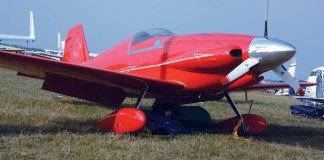
This year’s slate spans roughly twenty years of American civil aviation design, and the lineupleans heavily into airplanes that builders will appreciate for reasons that go beyond nostalgia. Monday opens with the Mid America Flight Museum’s 1934 Granville Brothers Gee Bee R-6 QED replica — the long-legged sister of the stubby R-1 racers, and a reminder that the Granvilles were chasing range and stability with a remarkably modern wing. Tuesday belongs to Shawn Honaker’s 1946 Aeronca Champ, the airplane that taught a generation to fly and, through its many derivatives, is still teaching new builders what a forgiving stick-and-rudder machine ought to feel like.
Wednesday brings something most attendees will never have seen in person: Tim Talen’s 1935 National Airplane and Motor Company Bluebird LP-4. Survivors of the pre-war light-plane field are scarce, and the Bluebird is a tidy study in how small manufacturers tried to crack the personal-aircraft market before the Cubs and Champs took over in great numbers.
Thursday’s feature is Jan Johnson’s 1944 Stinson L-5E, the workhorse liaison ship that dideverything from artillery spotting to medevac — clean stressed-skin construction, honest handling, and a maintenance logbook story that almost always involves a community. Friday closes the week with Will Kientz’s 1953 Temco T-35A Buckaroo, the tandem-seat trainer Temco hoped the Air Force would buy. They didn’t, and the surviving Buckaroos have become some of the more interesting orphan airplanes on the warbird-adjacent circuit.
More sessions will be added as the schedule firms up, according to chairman Ray Johnson, who notes that the value of the program is as much about the people as the aluminum and fabric. The owners are, more often than not, the mechanics too. The questions about cylinder choices, fabric systems, prop overhauls, and the small, fabricated parts that keep a 90-year-old airplane in the sky are the same questions builders are answering today in their own shops, on their own projects.
Bring a folding chair, a notebook, and a enjoy the aroma of warm castor oil when the OX-5 lights off. Updates and the running schedule are posted on the Vintage Aircraft Area page at eaa.org.
![Builder and pilot Mark Farver stands alongside his Continental IOX-340 powered RANS S-21. [Credit: Mark Farver]](https://www.kitplanes.com/wp-content/uploads/2026/09/Copy-of-build-38-Topaz-Gigapixel-2x-scale.jpg?w=218&h=150&crop=1 "Cross-Country in a Homebuilt RANS S-21 Outbound to Oshkosh")
![Oshkosh is more popular than ever with three-quarters of a million people in attendance at AirVenture 2026. [Credit: LeRoy Cook]](https://www.kitplanes.com/wp-content/uploads/2026/09/IMG_7321-Topaz-Gigapixel-2x-scale.jpg?w=218&h=150&crop=1 "Wide World of Airplanes")
![[Credit: Van's Aircraft]](https://www.kitplanes.com/wp-content/uploads/2026/07/IMG_5238.jpg?w=218&h=150&crop=1 "Part 22 Gets Real: Van’s Delivers the First MOSAIC-Certified Airplane")
![[Credit: Wikimedia Commons]](https://www.kitplanes.com/wp-content/uploads/2026/07/4_rutan_a_longez.jpg_preview.jpg?w=218&h=150&crop=1 "Rutan Symposium Turns to the Coming Canard Maintenance Crisis")
![The week ahead: a KC-135 tanker passes over the grounds at EAA AirVenture Oshkosh, where Phillips 66 will set up at tents #430 and #431. [Credit: USDA Forest Service]](https://www.kitplanes.com/wp-content/uploads/2026/07/Screenshot-2026-07-22-at-10.01.04-AM.jpg?w=218&h=150&crop=1 "Phillips 66 Sets Course for Oshkosh With Specials, Seminars—and Popsicles")
![The Rutan Model 76 Voyager circles Edwards Air Force Base in December 1986 as Dick Rutan and Jeana Yeager complete the first nonstop, unrefueled flight around the world. [Credit: NASA Armstrong Flight Research Center]](https://www.kitplanes.com/wp-content/uploads/2026/07/Screenshot-2026-07-20-at-11.02.07-AM.jpg?w=218&h=150&crop=1 "Behind the Voyager Flight: 40 Years of Quieter Cockpits")
![The Granville Brothers Gee Bee R-6 “Q.E.D.” being serviced before the 1934 MacRobertson Air Race; Mid America Flight Museum flies a replica of this aircraft. [Credit: Wikimedia Commons]](https://www.kitplanes.com/wp-content/uploads/2026/07/Screenshot-2026-07-17-at-3.09.57-PM.jpg?w=218&h=150&crop=1 "Vintage in Review Returns to AirVenture 2026 With 90-Year-Old Flyers")
![The newly-restored F-24 enjoying the morning sun. [All Images Credited to Mike Davenport]](https://www.kitplanes.com/wp-content/uploads/2026/05/DSC_0001.jpg?w=218&h=150&crop=1 "Golden Age Revival")
![[Credit: Mike Davenport]](https://www.kitplanes.com/wp-content/uploads/2026/02/DSC_0053.jpg?w=218&h=150&crop=1 "Pre-War Porterfield")