![Oshkosh is more popular than ever with three-quarters of a million people in attendance at AirVenture 2026. [Credit: LeRoy Cook]](https://www.kitplanes.com/wp-content/uploads/2026/09/IMG_7321-Topaz-Gigapixel-2x-scale.jpg?resize=1024,682)
Open this issue at the Builders Spotlight and you get a Zenith CH 701 built to a strict budget. Turn to the features and you see a Carbon Cub with a turbine engine affixed to the nose. Those two airplanes are separated by an order of magnitude in cost. One was amateur built. The other is dream-world variation on the quintessential light airplane.
Chris Heintz drew the CH 701 forty years ago for the builder who did not have much money but wanted STOL and utility performance. The airplane was called the “Sky Jeep” for that reason. Forty years on, Carson Stilson’s story puts numbers to it — what his build actually cost in today’s dollars, where the savings came from, and what those savings cost in hours. That is the useful kind of build report, because it does not pretend there is no tradeoff there.
John Hatz drew the plans for the CB-1 Hatz Biplane in the late 1960s for a builder with a different set of assets: time, a bandsaw, and patience for wood, fabric and wire. The Bantam is the lightened derivative, roughly 780 pounds empty, sized to a Jabiru 3300. Our look at the design starts this month. A sixty-year-old drawing package still producing new airplanes is worth understanding on its own terms, not just as nostalgia.
Between those poles sit the turboprop Cub and Andrew Robinson’s report on the Spirit Engineering SE-1. Different budgets, different shops, different definitions of finished.
Then there is Mark Farver and Carin Berolzheimer’s RANS S-21 Outbound, N319PG, built at Little River on the Mendocino coast and powered by a Titan IOX-340. I wrote that one, and I will tell you the part that stayed with me. Mark flew the airplane to Michigan’s Thumb and took his great-uncle Cliff Farver, who is 102 years old, on a flight he had promised since beginning the S-21 build.
Which is roughly Robinson’s point in Winging It this month. Characters in aviation are abundant. The interesting thing about a homebuilt has always been the person who decided to build it, and the two are really inseparable.
The departments run to the same idea from the practical end. Bill Wilson asks what a material choice actually commits you to — a question builders answer fast and regret slowly. Eric Stewart takes on cowl fabrication, which is where a lot of otherwise clean projects stop looking clean. Laurence MacNaughton walks through choosing a fire extinguisher, a subject nobody finds interesting and most people default on rather than decide. Turner closes the issue asking whether you should be carrying a parachute.
Four departments, four decisions, no single correct answer to any of them. That is the nature of the category. Nobody hands an amateur builder a specification and tells him he must comply.
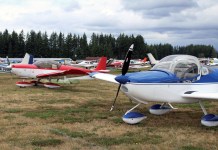
Our AirVenture recap this month is aimed squarely at builders. There is no shortage of Oshkosh coverage that is really airshow coverage. Our reports focus around the homebuilt camping area, the workshops, the kit manufacturers’ tents, and the regulatory news of the summer, which is covered there in full and which I will not repeat here. LeRoy Cook ads a nostalgic look at the American Bicentennial Oshkosh of 1976 and illustrates how much has changed at EAA AirVenture in that half-century.
One housekeeping item. If you showed us a project at Oshkosh and we took your name down, you will hear from us. We came home with more leads than we can run in a single issue, and that is the right problem to have. If we missed you, write to me directly. The best stories in this magazine arrive that way — not from a press release, but from somebody who spent four years in a garage and finally rolled it out.
This article first appeared in the 2026 September Issue of KITPLANES magazine.
![[Credit: Wikimedia Commons]](https://www.kitplanes.com/wp-content/uploads/2026/07/4_rutan_a_longez.jpg_preview.jpg?w=218&h=150&crop=1 "Rutan Symposium Turns to the Coming Canard Maintenance Crisis")
![The Granville Brothers Gee Bee R-6 “Q.E.D.” being serviced before the 1934 MacRobertson Air Race; Mid America Flight Museum flies a replica of this aircraft. [Credit: Wikimedia Commons]](https://www.kitplanes.com/wp-content/uploads/2026/07/Screenshot-2026-07-17-at-3.09.57-PM.jpg?w=218&h=150&crop=1 "Vintage in Review Returns to AirVenture 2026 With 90-Year-Old Flyers")
![[Credit: EAA]](https://www.kitplanes.com/wp-content/uploads/2026/06/vintage-in-review-herb-clark.jpg?w=218&h=150&crop=1 "Vintage in Review Returns to Oshkosh: Five Days, Five Stories, and a Living OX-5")