
In Part 1 I pontificated on the pros and cons of a polished finish and listed the minimal tools and materials needed to start polishing with Nuvite NuShine II. In this part, we do just that. The bulk of your polishing results as well the bulk of your time and effort come while cutting the initial shine with NuShine II F9—the focus of this article. Three bits of good news come with any attempt at polishing: It’s inexpensive to try, you will see results no matter how poorly you perform at first, and if you give up in favor of paint you’ll have done no harm.
Factors That Impact Results With NuShine II F9
The biggest challenge to efficient polishing is balancing the variables. Those variables are the amount of polish applied, the rotational speed of the buffer, the speed of movement over the surface, and the pressure that is applied against the surface. Here I try to quantify those variables. I offer this as a starting point. Just as I found that I get good results with a slower rotational speed than Nuvite recommends, you may find your results improve by deviating some from my recommendations.
Compounding Pad: Type, Condition, and Care
Initial polishing is done with a rotary buffer and wool compounding pads (at this stage an orbital buffer won’t make the cut). Always begin with a new wool compounding pad. No excuses. It must be new, it must be wool, and it must be a compounding pad, not a polishing pad. I use a 3M pad, part number 05719. If you’re only exploring your will to polish, buy one pad. If you are committed to polishing, buy two.

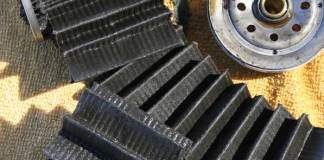
During use a pad will become matted and less effective. When that happens the pad should be spurred. During extended buffing sessions a pad can become saturated with polish, and spurring is no longer effective. Let the pad dry before spurring it. If you wish to keep polishing, switch to a backup pad.

Pads can be washed, but never wash one to use with another grade of polish. Wash them in a bucket of warm, soapy water—never in a washing machine. Rinse them well. Depending on the size of your project, at some point, like you, a pad may lose its enthusiasm for the job. Think of pads as consumable items and replace them when they seem to be wearing out.
Amount of Polish Applied
Nuvite NuShine II consists of a fine polishing substrate suspended in a carrier solvent. If too little polish is used for a given area it dries quickly and becomes ineffective. If too much is used it self-lubricates and becomes a thick, black coating that clogs the pad. My experience is that people use too much polish, at least at first. More is not better. There is a caveat (of course). When you begin polishing with a new pad, the pad will absorb some polish, just as a dry paintbrush absorbs paint. Therefore, you will need more polish than “normal” until the pad has stopped taking its angel’s share. Also, as a surface becomes polished, less polish is needed for each new pass in the same way a second coat of paint requires less paint. The key is to observe the results and regulate polish application and distribution accordingly.

Rotational Speed of the Buffing Pad
I estimate the speed of my rotary buffer to be 750-900 rpm. Nuvite recommends 2000 rpm, but my experience at higher speeds is the polishing compound gets flung from the surface while I spread it or the polish’s carrier burns off, leaving the remaining substrate ineffective. I recommend starting slow and adjusting the speed up (or down) as you gain experience. You’ll also find that surface friction slows the buffer during the first round of polishing. Don’t hesitate to adjust the buffer’s speed to accommodate the conditions.

Amount of Pressure Applied Against the Material
The mistake I most often make while polishing is applying too much pressure against the material. That tendency is triggered by the desire to speed the process along, but added pressure does not speed polishing. When polishing a horizontal surface the weight of the buffer is all the pressure that’s needed. Your hands do not push the buffer against the material, they only guide the buffer. On vertical surfaces, press against the material just enough to mimic the weight of the buffer.
Linear Speed Over the Surface
The speed at which I move the buffer over the surface is an area where I must remind myself to slow down. Frankly, polishing is boring and the urge to speed it along is exhibited by increasing pressure against the material and moving the buffer quickly over the surface. Neither help. Nuvite recommends a linear speed of 1 to 2 seconds per foot. I estimate my speed at 3 seconds per foot. (If that sounds fast, count “one thousand one, one thousand two…” to set the pace.) Experience will help you find the speed that works for you. I adjust my speed constantly, based on what I see happening as the polish is worked over the surface.

Contact Patch of the Buffing Pad
The buffer must be held at a slight angle to the surface so only a portion of the pad contacts the surface. Changing the buffer’s angle on either its pitch or roll axis provides control over which portion of the pad contacts the material. This lets you control the direction the pad spins over the grain and, critically, off a surface or over an edge.

various angles. This highlights a benefit of polishing skins before assembly (left). Use a microfiber towel to remove polish
residue from the edges of holes and panels and from around hardware. In the same way I bag each buffing pad after use, I also bag my cleanup rags to isolate them by grade of polish and to keep them free of debris (center). Residue that has dried can be softened with denatured alcohol prior to removal (right).
Flat Is Your Friend
I emphasized in Part 1 that polishing individual parts flat and fully supported on a workbench is the easiest and most efficient path to a shiny finish. Subassemblies (wings, tail, and fuselage) can be placed on sawhorses and rotated/flipped so each side can be polished at a comfortable height without having to support the weight of the buffer. I did the initial polishing (NuShine II grades F9 and C) of the individual skins of my Onex before assembly. I’ll do the final polish of the major subassemblies flat on sawhorses (a touch-up with NuShine II grade C and then grade S, to de-swirl). If you’re done or nearly done with your airframe there’s no way around the inconvenience and frequent discomfort of polishing vertical and inverted surfaces and, of course, future maintenance of a polished finish will be at mercy of your knees, shoulders, and back.

Making a Mirror With NuShine II Grade F9
My technique for polishing with NuShine II F9 is to make four separate passes over the surface, each with its own application of polish (think of each pass as a coat of paint). What distinguishes each pass is the manner in which the compounding pad contacts the surface. On the first pass I hold the buffer so the portion of pad contacting the surface is rotating parallel to the grain. The first pass takes the longest but yields encouraging results. I polish an entire part before making the second pass with the pad’s contact patch rotating perpendicular to the grain. Passes three and four are made while moving the buffer in overlapping circles. All passes with F9 will leave swirl marks, which NuShine II C will diminish and NuShine II S and an orbital buffer will eliminate.


Clean Up
At the completion of a polishing session, place the polishing pad in a sealed bag to keep it free of debris. Next, remove polish residue from the parts. Dried polish can be softened with denatured alcohol. If you don’t clean off the residue it will contaminate your polishing pad and introduce the coarse substrate into your fine polish, negating your effort to improve the shine.
Conclusion
Polishing is not difficult; it is time-consuming and…boring. Unless you are committed to polishing, test-polish a few square feet of 6061-T6 to see if your commitment to polishing runs as deep as the reflection you achieve. Having one wing done poorly is a bad look. There are no shortcuts to a polished finish, but it’s a look that’s hard to beat and one that enjoys many benefits (see Part 1). If you find you don’t have the gumption to polish an entire airframe you can always give up and paint. In the final part of this series we’ll hone the initial polish with NuShine II C, polish out the swirls, and look at ongoing maintenance of the polished surface.
![[Credit: Wikimedia Commons]](https://www.kitplanes.com/wp-content/uploads/2026/07/4_rutan_a_longez.jpg_preview.jpg?w=218&h=150&crop=1 "Rutan Symposium Turns to the Coming Canard Maintenance Crisis")
![[Credit: Lisa Turner]](https://www.kitplanes.com/wp-content/uploads/2026/02/Fuel-Selector.jpg?w=218&h=150&crop=1 "Fuel Follies")