
I’m going to start off with a reminder: You’ve checked that you put on the AN-818 B-nut and 819 sleeve before starting the flare, right? Right! You’ve been warned!
Fuel Line Requirements
Firewall-aft (FWA), rigid fuel lines fabricated from soft aluminum tubing (typically 3003 or 5052, both O [soft] temper) are the norm. There is (or should be) no relative motion between FWA fuel system components, and there is not the flame resistance requirement that we have firewall-forward (FWF). As such, aluminum tubing is an acceptable fuel line. The benefits compared to hose lines are low cost and ease of fabrication. They are potentially also a little lighter, and unless you are concerned with heating of the fuel, there’s no reason to firesleeve rigid lines.
However, FWF, aluminum tubing is generally considered unacceptable because: a) engine vibration can quickly cause aluminum lines to fatigue and crack, and b) aluminum lines will not pass the 15-minute flame test (see Part 23 FAR Sec 23.1191 for the full list of firewall requirements).
It is therefore customary to use either flexible, fire-sleeved hose or stainless steel tubing. Compared to aluminum, steel is considered to have an infinite fatigue life if stress limits are kept below a certain level (the “endurance limit” in the chart above). Aluminum, on the other hand, has no endurance limit; even the smallest stress (and here we mean reversed bending load cycles, i.e., vibration) counts against the fatigue life.

To be clear, steel will fatigue if you exceed the endurance limit, and you probably have no way of measuring the stress you are putting on lines. As such, I would generally try to avoid putting steel lines on the engine itself if a hose will work. And if you do use rigid lines, be sure to provide strain relief bends (i.e., no point-to-point straight lines) and sufficient support in the form of Adel clamps. Look at a prop governor line or fuel injection runners to get an idea of “sufficient.”
Because the SR-1 FWF packaging is quite tight, use of rigid fuel lines in certain parts of the fuel system presented packaging advantages (as compared to flexible hose). Note that these lines see no relative movement, as they are not connected to the engine; lines that do see relative motion use flexible hose, and that works fine anyway as those lines are not as packaging-constrained.
A Soft Start
There are numerous articles, chat threads, and videos available to instruct builders on the fabrication of aluminum fuel lines, so I’ll only cover a few basics here. However, the method I’m going to advocate for SS lines requires you to fabricate mockups from aluminum first. That is all for the better, since fuel lines are usually a once-and-done job on your homebuilt journey, so getting some practice with mockups before making the real deal is helpful. And you’ll probably be making aluminum lines FWA anyway, so you’ll need most of these tools and materials regardless.

Either 3003 or 5052 will work fine. Done correctly, either should last the life of the plane (FWA). 3003 is cheaper but comes in coils, so if straight tubing runs matter, then you’ll need to get 5052, which is sold in straight lengths, or buy a tubing straightener tool.
Acquire the proper tools for the job, namely a tubing bender and flare tool. You will also need some WD-40, Scotch-Brite, a magnifying glass, and calipers. I spray the WD-40 into the grooves of the tubing bender, as it helps the forming arm to slide a little easier as it bends the tubing. Same goes for the flaring cone.
Regardless of whether the line itself is aluminum or steel, either aluminum or steel line fittings (i.e., coupling sleeves and B-nuts) will work fine. If you are concerned about the above flame requirements, use steel. However, for certain fittings (such as NPT to AN male unions threaded into an oil cooler or aluminum engine block), it is highly recommended to use steel fittings and an anti-seize paste to avoid galling.


As noted above, because the steel tubing is a) expensive and b) more difficult to form than aluminum, I recommend making an initial set of lines from aluminum for use as a template. Unless you are a pro at this, you are probably going to use two to four times as much tubing as the actual line length: You will undoubtedly end up with lines that are too short or bent in the wrong place, you forgot to put on the B-nut and collar before flaring, etc. Working things out in aluminum is cheaper and easier than in steel.

Because it can be difficult to tell exactly where to start the bend on a straight piece of tubing, I keep a set of pre-bent tube templates with my bender that indicate where to align the tubing in the bender. I use the backside of the retention arm as my reference point and mark this reference point on the template tube. When prototyping a fuel line, I simply lay the template over the straight tubing where I want the curve and transfer the reference point.


To ensure satisfactory flares, it may be necessary to deburr the tube end before flaring. Smoothly breaking the inside corner prior to single flaring of ferrous—and, in some cases, non-ferrous—tubing is normally required to remove the cutoff burr that could otherwise create leakage paths across a substantial portion of the flare. Likewise, smoothly breaking the outside corner before single flaring—or breaking both the inside and outside corners before double flaring—is permissible on any tube material to minimize splitting.
Don’t take shortcuts—make these practice lines properly. Square up and deburr tubing ends before flaring, inspect flared ends with a magnifying glass to ensure there are no cracks in the flare, and measure the flare diameter on EVERY flare to make sure that it falls within limits (see chart below). Include the B-nut and collar so that you can ensure the line fits up snug/squarely and smoothly screws into the male AN fitting. This is all good practice and will get you in the mindset for doing the SS lines properly. And, if for whatever reason you aren’t able to fabricate the SS lines, you can send your templates to someone like AS Flightlines and they’ll be able to replicate your aluminum mockups.

Steel, the Real Deal
Once you are finished fabricating the aluminum lines, you can now replicate them in steel. You’ll match the line OD (i.e., ¼ inch, ⅜ inch, etc.), but I’d recommend dropping down in wall thickness. Aluminum lines are typically 0.035-inch wall, and while you can certainly use 0.035-inch wall SS, 0.028-inch wall is plenty strong and will be easier to bend and flare. Aircraft Spruce sells a variety of stainless tubing, and you can also find tubing online from vendors such as McMaster-Carr or OnlineMetals.com. Either 304 or 321SS are acceptable, but 304 will probably be cheaper. Double-check that it is listed as annealed or “soft.”

Prep the steel lines as you would aluminum, i.e., square the ends up (I prefer to do this with a belt sander and a square) followed by deburring (a light pass on the Scotch-Brite wheel for external burrs and a zero-degree deburring tool for internal burrs) and a final polishing with maroon Scotch-Brite (3M 3477). I recommend keeping the lines blown clean with compressed air as you work, to avoid inadvertently dropping shavings or other junk into the fuel pumps, filters, etc., that you are fitting to.


Do not use a Rolo-Flair for flaring the steel tubing. You’ll want a dedicated steel flaring tool. You can purchase these from your favorite aviation tools store, and Rigid also makes one—the 377 (model 41162). Regardless of what you buy, make sure it does 37° flares, not 45! I purchased the 377 and it made excellent, repeatable flares. The instructions were complete and easy to follow. As with the aluminum lines, I found that spritzing a bit of WD-40 facilitated both bending and flaring.

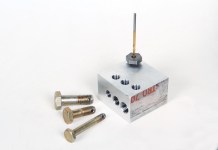
One point to note: The Rolo-Flair has a small finger that sets the depth of the tube in the jaws before flaring—the tube actually extends 0.050 inches (as close as I can measure) proud of the jaw, to provide excess material for the flare. The Rigid 377 (and as far as I can tell, analogous flare tools) doesn’t have a similar stop, and you’ll need to set that extension yourself. I have a set of shims from McMaster-Carr, and the 0.052-inch shim gave great results (see the pictures for details).


Because the steel lines are so much stiffer than aluminum, you really want to make sure your flares sit square and tight on the male cone of the AN fitting. Aluminum lines should of course do the same, but it’s possible to have a slight amount of misalignment in aluminum lines that gets straightened out when the B-nut tightens up. You never want to count on this, but especially not with steel lines—you’ll just end up with a leak. This is where flexible hose definitely has an advantage.
![The week ahead: a KC-135 tanker passes over the grounds at EAA AirVenture Oshkosh, where Phillips 66 will set up at tents #430 and #431. [Credit: USDA Forest Service]](https://www.kitplanes.com/wp-content/uploads/2026/07/Screenshot-2026-07-22-at-10.01.04-AM.jpg?w=218&h=150&crop=1 "Phillips 66 Sets Course for Oshkosh With Specials, Seminars—and Popsicles")